
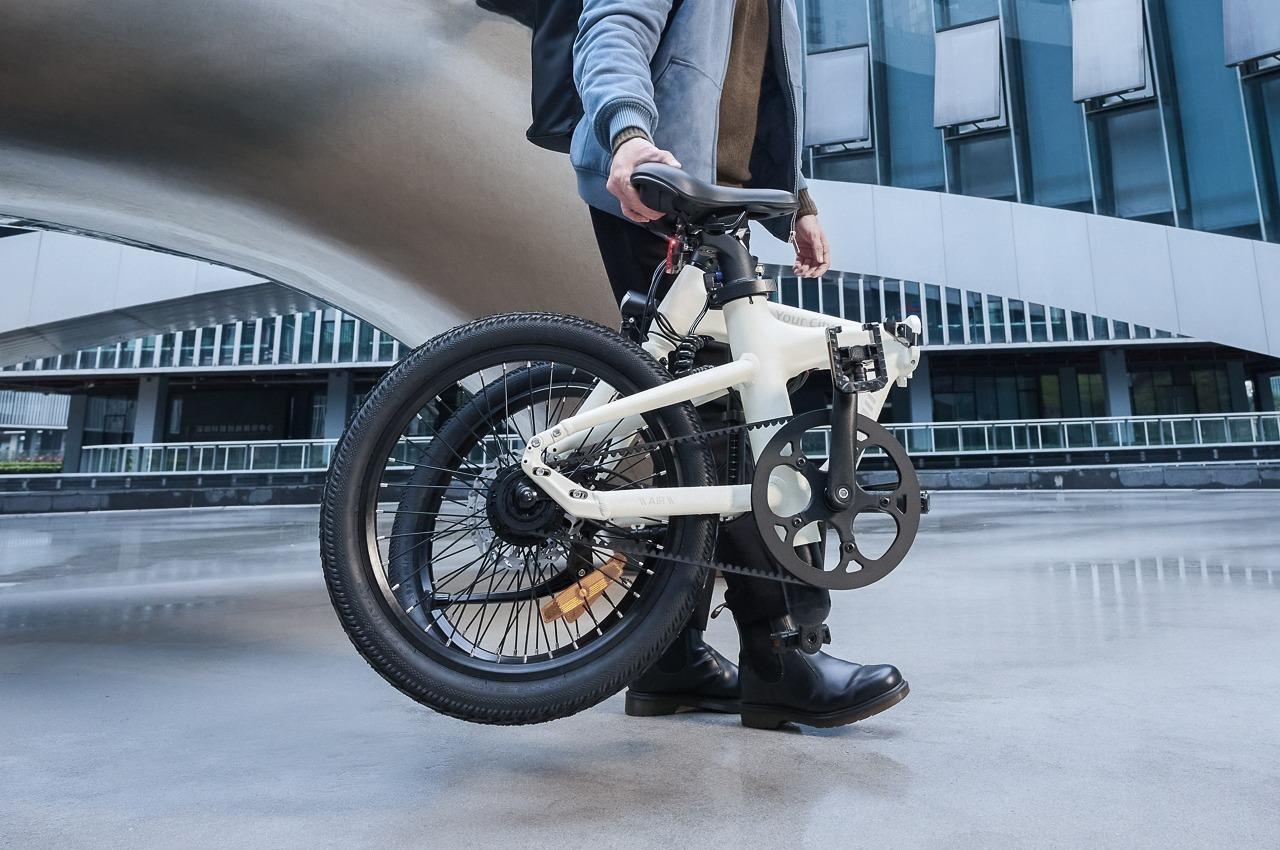
Folding bicycles seem simple—until you use them every day.
Folding electric bicycles are typically chosen for one obvious reason: convenience.
Easy to store. Easy to carry. Easy to transport.
Most buyers view folding e-bike manufacturers in this way—they focus on size, weight, and folding mechanism.
But once these bicycles are put into daily use, people's expectations will change.
Commuters don't fold their bicycles only once a day.
They rode it through the traffic.
Bring it into the elevator.
Please store it in a small space.
Repeat this step every day.
We've seen some folding bikes perform well in initial demonstrations, but after a few weeks of use, minor issues arise—the hinges loosen, the frame bends under load, or it feels unstable at high speeds.
These are not design flaws, but rather challenges encountered in actual use .
At OTMAR, we design folding e-bikes that are not only easy to carry, but also suitable for repeated daily use in urban environments .
According to the International Energy Agency , compact electric mobility solutions such as folding e-bikes are becoming increasingly popular in cities with limited storage space.
https://www.iea.org/reports/global-ev-outlook
This makes the role of reliable folding e-bike manufacturers more important than ever.
The folding mechanism is the most critical engineering aspect.
Unlike standard e-bikes, folding e-bikes introduce a key complexity: the folding structure itself.
The key to many design successes and failures lies here.
The folding mechanism must have the following characteristics:
- Sturdy enough to withstand the stress of riding.
- Sufficiently stable to maintain frame rigidity
- Simple enough for repeated daily use
| Structural regions | Engineering challenges |
|---|---|
| Frame hinge | We must resist long-term fatigue |
| Locking system | Requires safe and repeatable interaction |
| Joint Alignment | Affects driving stability |
| Folding joints | Precision must be maintained over time |
Organizations such as the European Cycling Federation emphasize that structural integrity is crucial for maintaining cyclist safety in urban cycling environments.
https://ecf.com
Professional folding e-bike manufacturers must ensure that the folding design does not affect the riding experience.
Portability and stability: trade-offs in core design
Every folding e-bike must strike a balance between two conflicting priorities:
- portability
- Stablize
If a bicycle is too light, it may feel unstable.
If it's made too sturdy, it will be difficult to carry.
This trade-off determines the nature of the entire product.
At OTMAR, we achieve this balance in the following way:
- Optimize the frame structure to achieve weight distribution
- Choose materials that maintain strength without being too heavy.
- Adjusting the geometry to maintain stability in a compact form
This ensures that the bicycle remains practical both when folded and when ridden.
A good folding e-bike manufacturer understands that portability alone is not enough—the bicycle must still feel like a complete riding system.
Unique wear marks will form with daily use.
Folding electric bicycles are used more frequently than regular bicycles.
They are:
- Repeatedly fold and unfold
- Lift and carry
- Stored in a small space
- Transport by vehicle
This causes different types of wear and tear compared to a regular bicycle.
Key pressure points include:
| Usage Operation | Influence |
|---|---|
| Folding loop | The pressure on the hinges and locking system |
| carry | Loads on frame nodes |
| Storage | Misalignment may occur |
| Reuse | Accelerated component wear |
At OTMAR, we design folding bicycles that can not only handle riding conditions, but also these repetitive movements.
This includes a reinforced hinge system, a durable locking mechanism, and precise joint engineering.
A reliable folding e-bike manufacturer must design for durable handling , not just riding performance.
Case Study: Overemphasizing Portability
An East Asian dealer has launched a folding electric bicycle that emphasizes lightweight design.
The product is portable and compact when folded – exactly what the market initially needed.
However, after several months of use, the feedback began to change.
Users have reported a decrease in bicycle stability while riding. Some users have noticed that the frame wobbles slightly after repeated folding.
The problem is not failure, but imbalance.
Following the collaboration with OTMAR, the distributor adopted a design that slightly improved structural strength while maintaining acceptable portability.
The result is a more stable riding experience and improved long-term durability.
Customers accepted the slight increase in weight because the bicycle felt more reliable.
This illustrates a key point:
Professional folding electric bicycle manufacturers must strike a balance between convenience and structural integrity.
Certification and safety of small electric bicycles
Despite their compact size, folding bicycles must meet the same safety and regulatory standards as other electric bicycles.
| Certification | Purpose |
|---|---|
| Central Electric | European market compliance |
| EN15194 | Electric bicycle standards |
| UL 2849 | Electrical system safety |
| United Nations 38.3 | Battery transportation compliance |
According to UL Solutions , all electric mobility products, regardless of size, must undergo electrical safety verification.
https://www.ul.com
Reliable folding e-bike manufacturers incorporate these standards into their product designs to ensure safe operation in everyday commuting environments.
Logistical advantages of folding electric bicycles
One practical advantage of folding bicycles is their high logistical efficiency.
Due to their compact design, they offer more flexible transportation options:
| Packaging type | benefit |
|---|---|
| Folding Assembly | Ready to use, smaller in size |
| SKD packaging | Further cost optimization |
| CKD Packaging | Maximum transportation efficiency |
In this way, distributors can reduce transportation costs while ensuring product supply.
A professional folding electric bicycle manufacturer is leveraging this advantage to improve supply chain efficiency.
OTMAR: Folding Bicycles Designed for Real Urban Life
Folding electric bicycles are not only designed to save space, but also to adapt to people's actual travel habits in the city.
OTMAR focuses on manufacturing folding electric bicycles that are both portable and durable, ensuring reliable performance in everyday use.
You can learn about our electric bicycle and electric tricycle solutions here:
https://www.otmarx.com/
If you are planning to develop or procure folding electric bicycles for your market, our team is ready to support your project:
https://www.otmarx.com/en/contact-us
The value of a folding bicycle lies not in how small it is when folded, but in its performance in everyday use.