
What Should a B2B Buyer Really Look for in a Waterproof Electric Bike?
A waterproof electric bike is not simply an e-bike that can be ridden through rain. For professional buyers, the term needs to be translated into measurable engineering requirements.
An electric bicycle combines a battery, motor, controller, display, wiring harness, connectors, lights, charging port, sensors, mechanical components, and frame interfaces. These parts may have different levels of protection from water.
This means a statement such as “the bike is waterproof” is not enough for a distributor, importer, private-label brand, or commercial fleet buyer to approve a product.
A better purchasing process begins with several more precise questions:
-
What level of water exposure is expected during normal use?
-
Which electrical components have documented ingress protection?
-
Does the published protection level apply to a component or the entire system?
-
How are connectors and charging interfaces protected?
-
What happens after repeated exposure to rain and wet-road spray?
-
How should the product be cleaned?
-
What inspection is required after wet use?
-
Does an OEM component change affect the original environmental protection?
-
Can the supplier provide configuration-specific documentation?
-
Can the factory reproduce the approved sample consistently during bulk production?
These questions matter because “waterproof” is often used as a marketing term, while professional procurement requires a technical specification.
For buyers evaluating potential OEM platforms, OTMAR currently publishes several electric bike models for city, touring, commuting, and mixed-road applications.
Therefore, a buyer requiring verified wet-weather performance should confirm the final configuration and applicable testing directly before bulk production.
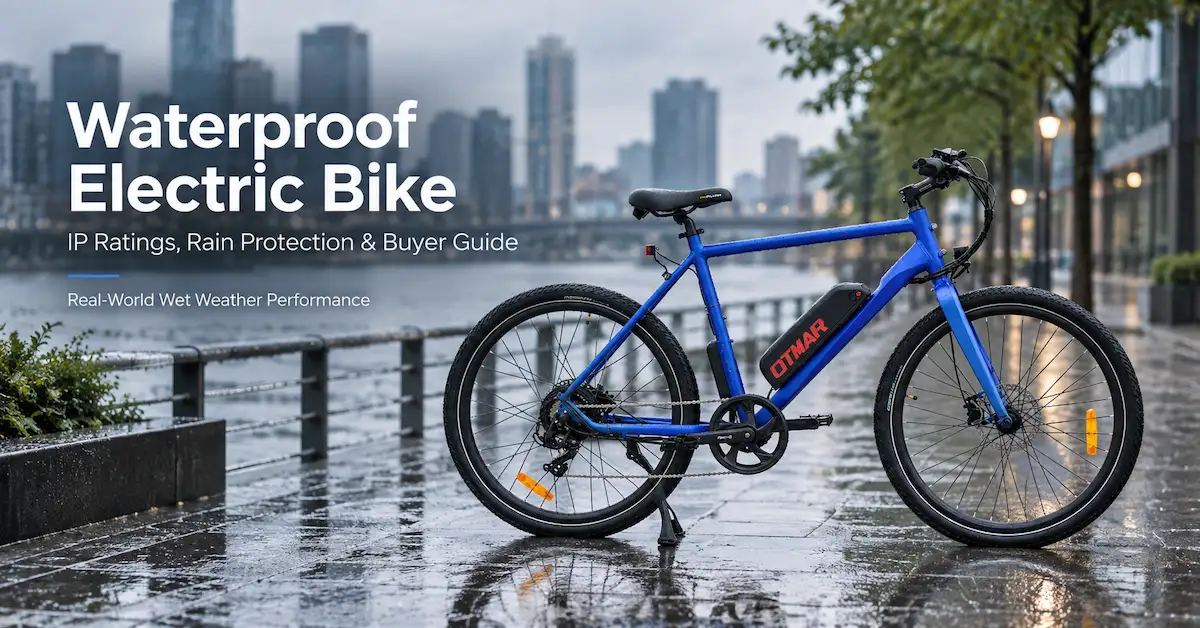
What Does “Waterproof Electric Bike” Actually Mean?
The word “waterproof” often creates the impression that water cannot enter or damage a product.
For an electric bike, that interpretation is too broad.
A bicycle may perform normally during everyday rain but still be unsuitable for:
-
Submersion
-
Flooded roads
-
Deep water crossings
-
High-pressure washing
-
Continuous outdoor storage
-
Severe storms
-
Saltwater exposure
-
Damaged battery housings
-
Open charging ports
-
Loose connectors
For this reason, water-resistant electric bike is often a more technically useful concept than simply saying “waterproof.”
What matters is the defined operating condition.
Light Rain Is Not the Same as Water Immersion
A commuter riding for 20 minutes during light rain experiences a different water-exposure profile from a bike being temporarily submerged.
Likewise, road spray from a tire is different from direct water jets during cleaning.
Commercial buyers should separate these conditions rather than grouping them together.
Typical exposure scenarios include:
-
Light rain
-
Heavy rain
-
Tire splash
-
Puddles
-
Mud
-
Outdoor parking
-
Repeated washing
-
Commercial all-day operation
-
Coastal moisture
-
Storage in humid environments
Each use case may require a different combination of electrical protection, mechanical design, maintenance, and documentation.
Rain Resistance Is a System Requirement
An e-bike can contain a highly protected battery while another electrical interface remains vulnerable.
The final wet-weather reliability of the bicycle may depend on:
-
Battery enclosure
-
Battery contacts
-
Motor housing
-
Controller
-
Display
-
Wiring harness
-
Electrical plugs
-
Cable-entry points
-
Sensors
-
Lights
-
Charging connector
This is why B2B buyers should evaluate the electrical system rather than looking only at one component.
Waterproof vs. Water-Resistant Electric Bikes
The difference between “waterproof” and “water-resistant” is important for sourcing.
A supplier may use “waterproof” to communicate general outdoor usability.
That does not automatically establish that the product has passed a specific water-ingress test.
Before accepting the term, ask:
Which component has been tested, what protection level applies, what standard was used, and does the documentation match the exact production configuration?
A professional supplier should be able to clarify what the claim actually covers.
A Component Rating Is Not Automatically a Whole-Bike Rating
Imagine that a battery has a documented ingress-protection level.
This does not automatically mean the:
-
Motor
-
Display
-
Controller
-
Connectors
-
Wiring
-
Lights
-
Charging port
have the same protection.
It also does not automatically mean the complete e-bike has been tested as a single system to the same level.
For commercial procurement, these distinctions should be recorded in the specification.
OEM Customization Can Change the Original Condition
Private-label e-bike projects frequently involve changes to:
-
Battery
-
Display
-
Controller
-
Lighting
-
Wiring
-
Connectors
-
Charger
-
Frame
-
Accessories
Any of these changes can affect electrical interfaces.
Therefore:
A tested base configuration should not automatically be treated as evidence for every customized configuration.
That is particularly important for buyers ordering private-label products for rainy markets.
Understanding Electric Bike IP Ratings
One of the most useful tools for discussing water resistance is an IP rating.
IP classifications describe defined levels of enclosure protection.
For sourcing teams, the purpose of the IP rating is not simply to find the largest number.
The purpose is to understand:
-
What was tested?
-
To what level?
-
Under what conditions?
-
Does the result apply to your product configuration?
How to Read an IP Code
An IP designation may appear as:
IP54
or:
IPX5
In a two-digit code, the first number relates to protection against solids or dust.
The second number relates to water protection.
An “X” indicates that the corresponding characteristic is not specified in that designation.
It should not be interpreted as a perfect score.
Common Water-Protection Levels Relevant to E-Bikes
| Rating Example | General Interpretation | What a Buyer Should Verify |
|---|---|---|
| IPX4 | Protection against splashing water under defined testing | Which component was tested and whether normal rain is within intended use |
| IPX5 | Protection against water jets under defined testing | Test scope, component identity and cleaning limitations |
| IPX6 | Protection against stronger water jets under specified conditions | Whether the rating applies to a component or complete system |
| IPX7 | Temporary immersion protection under defined test conditions | Depth, duration and tested enclosure |
| IP54 / IP55 | Includes both solids and water protection information | Both digits and the exact product covered |
| IP65 | Higher dust and water-jet enclosure protection | Whether the complete e-bike or only an individual component is covered |
An IP code should be treated as technical evidence attached to a specific product or enclosure.
It should not be expanded into claims the documentation does not support.
Why “IPX5 Battery” Does Not Mean “IPX5 Electric Bike”
This is one of the most important sourcing distinctions.
Suppose an e-bike battery is documented as IPX5.
A buyer should not automatically advertise:
“The complete electric bike is IPX5.”
The battery is only part of the vehicle.
The complete electrical system may include several independent components.
Battery
The battery may have its own enclosure and seal design.
Motor
The motor may have a different level of environmental protection.
Display
The display is exposed directly to rain and may use another housing design.
Controller
The controller may be installed inside the frame or in another enclosure.
Connectors
Electrical plugs create interfaces between components and may require separate sealing.
Lights
Lighting components may have their own environmental specification.
Therefore, the most accurate technical description may sometimes be:
“The battery has a documented IP rating of X.”
rather than:
“The entire e-bike is waterproof to X.”
This precision improves trust and reduces downstream warranty disputes.
Which Areas of an Electric Bike Are Most Vulnerable to Water?
Water-related failures do not always begin with the largest electrical component.
Interfaces are often more important.
Battery Enclosure and Battery Mount
The battery is a major area of concern because it contains high-energy electrical cells and associated electronics.
Buyers should review:
-
Housing construction
-
Sealing surfaces
-
Mounting method
-
Battery lock
-
Connector location
-
Charge interface
-
Enclosure damage resistance
-
Replacement procedure
An integrated battery can offer a clean appearance and protected placement, but frame integration by itself does not establish a particular waterproof rating.
For example, the OTM-M9 is publicly described as a 26-inch city e-bike with a 500W rear-drive configuration and a hidden Samsung battery.
For a buyer targeting rainy commuter markets, that integrated design may be one factor worth evaluating.
However, the published product page does not currently provide a verified model-level IP rating.
That information therefore needs separate confirmation.
Battery Contacts
Battery contacts deserve particular attention on removable-battery systems.
Inspect:
-
Contact positioning
-
Water exposure
-
Contamination
-
Battery seating
-
Locking
-
Repeated insertion cycles
-
Corrosion risk
Commercial fleets that swap batteries frequently may put much more mechanical wear on these interfaces than an individual consumer.
Charging Ports
A charging port is a direct electrical interface and should be part of every wet-weather evaluation.
Buyers should examine:
-
Port location
-
Protective cover
-
Cover retention
-
Seal quality
-
User access
-
Exposure to wheel spray
-
Risk of leaving the cover open
A well-designed cap is useful only if it remains secure after repeated charging cycles.
Charging After Wet Use
Procurement documentation should clearly explain how operators should handle charging after the bicycle has been exposed to rain.
A buyer should not assume that “water-resistant bike” means “safe to connect a charger while electrical interfaces are visibly wet.”
Operating instructions and charging procedures should be part of the commercial package.
Motor Housing and Cable Entry
Motors operate close to the road surface.
Depending on the design, they can be exposed to:
-
Rain
-
Dust
-
Mud
-
Water spray
-
Road debris
Evaluation should include:
-
Motor housing
-
Axle region
-
Cable entry
-
Electrical connector
-
Wire routing
-
Service procedure
The motor's rated wattage does not tell a buyer anything about its environmental sealing.
Power and ingress protection should be treated as separate specifications.
Controller Protection
The controller may be less visible than the motor or battery, but it remains a critical electrical component.
Depending on the bicycle design, it may be:
-
Inside the frame
-
Near the battery
-
In a dedicated housing
-
Installed elsewhere on the bicycle
Buyers should confirm:
-
Controller location
-
Enclosure protection
-
Cable entry
-
Connector design
-
Service access
A controller that is difficult to inspect can also increase maintenance time in commercial fleets.
Display and Handlebar Controls
Displays are highly exposed.
They may experience:
-
Rain
-
Condensation
-
Rider handling
-
Impact
-
UV exposure
-
Repeated button use
A buyer sourcing an e-bike for year-round use should therefore verify the environmental specification of:
-
Display
-
Control buttons
-
Throttle, if applicable
-
Handlebar switches
-
Related connectors
A waterproof battery cannot compensate for a display failure caused by poor environmental protection.
Wiring Harnesses and Connectors
Electrical connectors are among the most easily overlooked details during catalog sourcing.
A professional inspection should examine:
-
Connector type
-
Locking method
-
Cable orientation
-
Connector location
-
Water drainage
-
Cable strain
-
Grommets
-
Frame-entry points
-
Abrasion risk
Poor cable routing may create problems even when the electrical components themselves are well designed.
What Type of Buyer Needs a Waterproof Electric Bike?
Different applications create different water-resistance requirements.
The appropriate specification should come from the use case.
Daily Commuters
Typical commuter exposure may include:
-
Rain during travel
-
Wet pavement
-
Tire spray
-
Puddles
-
Outdoor bicycle parking
-
Damp storage
For these customers, water resistance should be evaluated together with:
-
Fenders
-
Tires
-
Brakes
-
Lighting
-
Battery access
-
Cargo capability
-
Maintenance
OTMAR's electric bike commuting guide also treats weather exposure as one element in a broader commuter-selection process.
This is important.
A commuter bicycle should not be selected only because a supplier advertises an IP number.
The complete vehicle still needs to fit the daily route.
Delivery Fleets
Delivery use can be more demanding than ordinary commuting.
A delivery bicycle may operate for several hours through changing weather.
Exposure can include:
-
Rain
-
Repeated road spray
-
Puddles
-
Dirty roads
-
Frequent stops
-
Long shifts
-
Repeated charging
-
Cargo loads
Fleet buyers should therefore test wet-weather operation as part of a broader duty-cycle evaluation.
OTMAR's food delivery e-bike guide emphasizes the importance of evaluating actual route, load, braking, battery use and maintenance needs before fleet deployment.
The same logic should apply to rain performance.
Delivery Testing Should Reflect Real Operation
A meaningful test could combine:
-
Representative load
-
Typical route
-
Wet roads
-
Stop-and-go operation
-
Battery use
-
Braking
-
Lighting
-
Post-ride charging
-
Inspection
A five-minute demonstration around a factory yard does not reproduce the duty cycle of an eight-hour commercial shift.
Rental Operations
Rental bikes face a different risk profile because operators do not control how every customer treats the product.
Users may:
-
Leave bikes in rain
-
Ride through large puddles
-
Return bikes dirty
-
Damage port covers
-
Mishandle removable batteries
-
Ignore warning signs
Rental buyers should therefore consider:
-
Robust component interfaces
-
Easy inspection
-
Standard replacement parts
-
Clear user instructions
-
Simple charging procedures
-
Corrosion checks
-
Fast diagnostic access
For a rental fleet, serviceability can be almost as important as the initial IP specification.
Campus and Property Mobility
Campuses, hotels, industrial properties, resorts, and facilities may use e-bikes for:
-
Staff transport
-
Security patrol
-
Maintenance
-
Equipment movement
-
Guest mobility
These applications can involve repeated outdoor parking.
Buyers should define:
-
Storage location
-
Charging environment
-
Cleaning procedure
-
Weather exposure
-
Daily distance
-
Maintenance resources
-
Rider turnover
A product selected for a private commuter is not automatically optimized for institutional fleet use.
Mixed-Road Use
Mixed-road riders may encounter:
-
Gravel
-
Mud
-
Uneven pavement
-
Puddles
-
Dirt
-
Road splash
The OTM-K6 is publicly described with a 24-inch platform, 750W rear motor, wider tires, front suspension, disc brakes and a rear rack.
These published characteristics can make it relevant as a starting platform for mixed-surface evaluation.
However, they do not establish a specific waterproof rating.
For projects involving frequent mud or rain, buyers should request separate environmental-protection information.
Is a Higher IP Rating Always Better?
Not necessarily.
The correct objective is not to buy the highest possible number.
The objective is to specify the appropriate protection for the real operating environment.
Higher environmental protection may affect:
-
Component selection
-
Cost
-
Supplier availability
-
Serviceability
-
Product development
-
Testing
-
Lead time
A commuter bicycle used mainly in moderate urban conditions may not require the same specification as a commercial vehicle that operates outdoors throughout the day.
Over-specification can increase cost.
Under-specification can increase:
-
Failures
-
Warranty claims
-
Downtime
-
Replacement parts
-
Customer dissatisfaction
The correct balance comes from application analysis.
Why Product Design Matters Beyond the IP Rating
Two e-bikes can use electrical components with similar documented ratings and still perform differently in service.
Consider two hypothetical systems.
Bike A
-
Protected connectors
-
Controlled cable routing
-
Secure charging-port cover
-
Proper grommets
-
Good drainage
-
Easy inspection access
Bike B
-
Exposed plugs
-
Loose charging-port cover
-
Cables rubbing against the frame
-
Poorly placed connectors
-
Difficult maintenance access
Even if some individual components carry similar IP ratings, their long-term fleet performance may not be identical.
This is why environmental reliability involves four layers:
Component Protection
How well individual enclosures resist water.
System Integration
How components are connected and positioned.
Manufacturing Quality
Whether every production unit is assembled consistently.
Maintenance
Whether seals, covers, connectors, and wiring remain in good condition over time.
Professional buyers should evaluate all four.
What Documents Should You Request From a Waterproof E-Bike Supplier?
A serious RFQ should ask for evidence.
“Please quote waterproof e-bike” is not detailed enough.
Instead, request documentation connected to the final configuration.
Component-Level IP Information
Ask which ratings are available for:
-
Battery
-
Motor
-
Display
-
Controller
-
Lights
-
Electrical controls
-
Relevant connectors
If no rating is available, ask the supplier to state that clearly.
Absence of a published rating should not be replaced by an invented number.
Applicable Testing
Ask:
-
What test was conducted?
-
Which standard or test procedure was used?
-
Which product was tested?
-
Was it a component or finished bike?
-
Who performed the test?
-
Is documentation available?
This changes the discussion from marketing to evidence.
Exact Tested Configuration
For OEM projects, confirm whether the tested system used the same:
-
Battery
-
Motor
-
Controller
-
Display
-
Wiring
-
Connector
-
Charger
-
Lighting
as the proposed production version.
If a critical electrical component changes, the applicability of earlier testing may need to be reassessed.
Report Traceability
Where formal documentation exists, procurement teams should request information such as:
-
Report identification
-
Tested product
-
Date
-
Testing organization
-
Applicable requirement
-
Result
Traceability is especially important when the product will be marketed using a specific technical claim.
Cleaning and Operating Instructions
Request the supplier's instructions for:
-
Rain use
-
Cleaning
-
Drying
-
Storage
-
Battery removal
-
Charging after wet use
-
Inspection
Clear operating limitations are a sign of technical maturity, not weakness.
How Should Buyers Test a Waterproof Electric Bike Sample?
Sample approval should happen before mass production.
For wet-weather projects, the sample should represent the intended final configuration as closely as possible.
Step 1: Freeze the Sample Specification
Record the approved:
-
Frame
-
Motor
-
Battery
-
Controller
-
Display
-
Wiring
-
Connectors
-
Lighting
-
Charger
-
Brakes
-
Tires
-
Accessories
This creates a reference configuration.
Without a reference, a factory and buyer may unknowingly evaluate different versions.
Step 2: Conduct a Pre-Test Inspection
Before water exposure, inspect:
-
Battery installation
-
Port covers
-
Connectors
-
Wiring
-
Display housing
-
Cable-entry points
-
Motor cable
-
Visible seals
-
Physical damage
A defective pre-production sample should not be treated as a valid representation of an approved design without investigation.
Step 3: Define the Water Test
If the project requires a formal IP claim, the test should follow the applicable procedure.
Do not improvise by using uncontrolled:
-
Pressure washers
-
Full immersion
-
Extremely strong hoses
-
Extended underwater exposure
unless those conditions form part of the actual test requirement.
A Rain Test and an IP Test Are Not Necessarily the Same
A practical rain ride can provide useful application feedback.
It does not automatically replace standardized IP testing.
This distinction should remain clear in procurement documentation.
Step 4: Perform Functional Checks
After the defined exposure, test:
-
Power system
-
Motor assistance
-
Display
-
Buttons
-
Lighting
-
Battery connection
-
Brake sensors if used
-
Charging interface
-
Error codes
Intermittent faults deserve particular attention because moisture-related issues may appear after the immediate exposure period.
Step 5: Inspect Relevant Interfaces
Where appropriate, look for:
-
Moisture
-
Corrosion
-
Dirt
-
Loose connectors
-
Seal movement
-
Damaged covers
Inspection should follow the manufacturer's service method.
Do not dismantle sealed components in a way that compromises the product simply to conduct an informal check.
Step 6: Repeat the Real Duty Cycle
For commercial buyers, one test cycle may not be enough.
A more representative pattern could be:
Ride → wet exposure → inspection → drying → charging → repeat
The purpose is to simulate use, not simply to create a dramatic water demonstration.
Wet-Weather Safety Is More Than Electrical Waterproofing
An e-bike can remain electrically functional in rain while still becoming more difficult to ride.
Wet roads affect:
-
Tire grip
-
Braking distance
-
Visibility
-
Rider control
These should be part of the purchasing decision.
Tires
Wet traction depends on several variables.
Check:
-
Tread
-
Tire width
-
Compound
-
Pressure
-
Surface
-
Vehicle load
A wide tire does not automatically guarantee better wet-road grip.
The intended road surface matters.
Brakes
Braking should be evaluated under realistic conditions.
Buyers should consider:
-
Brake type
-
Rotor condition
-
Pad performance
-
Modulation
-
Loaded stopping
-
Repeated braking
-
Maintenance
A product description saying “disc brakes” is useful, but it is not a complete commercial braking specification.
Fenders
Fenders can reduce spray reaching the rider and parts of the bicycle.
They do not create an IP rating.
OTMAR's City eBike range includes city-oriented platforms where features such as racks, fenders, brakes and integrated electrical systems can be evaluated together according to the intended commuter application.
For wet-weather sourcing, these practical components complement environmental protection rather than replace it.
Lighting
Rain can reduce visibility.
A wet-weather specification may therefore include:
-
Front light
-
Rear light
-
Reflective elements
-
Appropriate tire selection
-
Reliable controls
A strong rain-use bike should be considered as a complete mobility system.
Why High-Pressure Washing Can Be More Demanding Than Rain
Commercial fleet operators should pay close attention to cleaning procedures.
A bike may tolerate normal rainfall but experience much more concentrated water pressure during washing.
Water directed at close range can reach:
-
Electrical connectors
-
Battery contacts
-
Bearings
-
Cable entries
-
Motor interfaces
-
Frame openings
Therefore, “safe in rain” should never automatically be interpreted as “safe for pressure washing.”
A Practical Fleet Cleaning Process
Subject to the manufacturer's instructions, a cleaning procedure may include:
-
Turn the e-bike off.
-
Follow the approved battery procedure.
-
Avoid inappropriate concentrated water pressure.
-
Clean the frame and tires using suitable methods.
-
Avoid directing water into electrical interfaces.
-
Dry critical areas.
-
Inspect connectors and charging interfaces.
-
Reassemble correctly.
-
Perform a functional check.
The final cleaning procedure should come from the product's actual design and operating instructions.
Water Resistance Can Change During the Product Life Cycle
A new sample is not the same as a bike that has completed thousands of commercial riding cycles.
Environmental protection can be affected by:
-
Seal wear
-
Battery removal
-
Connector wear
-
Crashes
-
Port-cover damage
-
Cable abrasion
-
Improper repair
-
Replacement parts
-
Incorrect reassembly
-
Corrosion
Fleet buyers therefore need periodic inspection.
Suggested Wet-Weather Maintenance Checklist
| Area | Inspection Focus |
|---|---|
| Battery housing | Cracks, deformation, visible damage |
| Battery mounting | Fit, lock, looseness |
| Contacts | Moisture, contamination, corrosion |
| Charge port | Cover condition and closure |
| Wiring | Abrasion, cuts, excessive movement |
| Connectors | Seating and damage |
| Display | Housing damage and function |
| Lights | Operation and electrical connection |
| Cable entries | Grommets and sealing condition |
| Frame | Areas that trap dirt or water |
This kind of checklist can reduce uncertainty in commercial fleets.
How OEM Customization Can Affect Waterproof Performance
OEM projects create more opportunity for differentiation, but they also introduce configuration risk.
OTMAR's broader electric bike manufacturing content discusses product configuration, electrical integration, sample development, assembly, inspection and OEM/ODM requirements.
Environmental protection should be managed throughout that same process.
Battery Changes
A new battery can affect:
-
Enclosure
-
Frame opening
-
Connector
-
Mount
-
Lock
-
Charge port
-
Cable routing
A visually similar replacement battery should not automatically be treated as technically identical.
Display Changes
Changing the display may change:
-
Connector
-
Cable
-
Control buttons
-
Housing
-
Mounting method
Therefore, environmental-protection evidence should be reviewed after such a change.
Controller Changes
Changing the controller may affect:
-
Housing
-
Location
-
Wire routing
-
Connector count
-
Service access
Lighting Changes
Adding electrical accessories creates additional interfaces.
These may include:
-
Extra wiring
-
Junctions
-
Connectors
-
Switches
Every new electrical interface deserves consideration.
Frame Changes
Frame customization can introduce:
-
New holes
-
Cable entries
-
Grommets
-
Battery openings
-
Mounting points
This means structural customization and electrical integration cannot be treated separately.
What Should Be Included in a Waterproof E-Bike OEM Specification?
For buyers developing a wet-weather product, the specification should go beyond color and logo.
A useful document can include:
-
Target market
-
Intended application
-
Expected rain exposure
-
Cleaning method
-
Parking conditions
-
Battery model
-
Motor configuration
-
Controller
-
Display
-
Connector requirements
-
Charging port
-
Cable routing
-
Lighting
-
Required component IP levels
-
Sample test procedure
-
Post-test acceptance criteria
-
Production inspection
-
Packaging requirements
-
Replacement-parts control
This makes the OEM conversation more efficient.
Instead of asking a factory for “a waterproof city bike,” the buyer provides a measurable project brief.
Buyers evaluating OTMAR as a potential supplier can review its company information and current product platforms before discussing project-specific requirements.
IP Rating Is Not the Same as Overall Safety Certification
This is another common misunderstanding.
Water ingress is one technical area.
It does not automatically establish:
-
Battery safety
-
Charger safety
-
Complete electrical-system compliance
-
Mechanical safety
-
Market legality
-
EMC compliance
-
Braking performance
Likewise, a general company certification statement does not automatically mean that every model and customized configuration carries every listed certification.
B2B buyers should use a compliance matrix.
Example Procurement Document Matrix
| Requirement | What to Verify |
|---|---|
| Water ingress | Applicable component or system documentation |
| Battery | Battery-specific documentation required for target market and logistics |
| Electrical system | Relevant product/system compliance |
| Charger | Charger specification and applicable approvals |
| Final model | Approved configuration |
| Destination market | Market-specific requirements |
| Manufacturing | Quality-control and final-inspection plan |
This is much more reliable than asking a supplier:
“Does the bike have CE, UL and waterproof certification?”
Each question may refer to a different technical scope.
Which OTMAR Models Could Be Evaluated for Wet-Weather Projects?
OTMAR currently publishes multiple electric-bike platforms.
The table below uses only publicly stated product characteristics.
It does not assign an unpublished waterproof rating.
| Model | Published Characteristics | Potential Evaluation Scenario | Additional Data to Confirm |
|---|---|---|---|
| OTM-M9 | 26-inch city bike, 500W rear drive, hidden Samsung battery, disc brakes | Urban commuting | Component IP ratings, connector protection, rain testing |
| OTM-C1 | 26-inch, 500W rear drive, Samsung battery, aluminum frame, rear rack, fenders | Utility commuting and daily transport | Battery/controller protection, wet-road testing, charging interface |
| OTM-Q20 | Step-through frame, integrated battery, dual suspension, wider tires, lights, disc brakes, rack | Comfort-oriented urban or mixed-road use | Electrical-system protection, IP documentation, wet braking |
| OTM-K6 | 24-inch, 750W rear motor, wider tires, front suspension, disc brakes, rack | Mixed-surface projects | Water protection, battery specification, wiring protection |
Buyers can review additional products through OTMAR's electric bike catalog.
The correct conclusion is not:
“Model X is OTMAR's most waterproof e-bike.”
The currently published information does not support that ranking.
The more accurate conclusion is:
These models offer different mechanical and electrical platforms that can be evaluated against a buyer's specific wet-weather requirements.
This distinction protects both supplier credibility and buyer decision quality.
What Questions Should You Ask a Waterproof Electric Bike Manufacturer?
A good sourcing discussion should replace broad questions with technical ones.
Instead of Asking: “Is the Bike Waterproof?”
Ask:
Which components have documented ingress protection, and what ratings apply?
Instead of Asking: “Can It Be Used in Rain?”
Ask:
What rain or water-exposure conditions are included in the intended operating environment?
Instead of Asking: “Is the Battery Waterproof?”
Ask:
What environmental-protection information is available for the battery enclosure, connector and charging interface?
Instead of Asking: “Can We Change the Battery?”
Ask:
If the battery changes, which environmental tests or documents need to be reviewed again?
Instead of Asking: “Can It Be Used for Delivery?”
Ask:
Can the final configuration be tested under our expected load, route, weather, operating hours and charging schedule?
These questions lead to more useful engineering discussions and more accurate quotations.
How Does Wet-Weather Reliability Affect Total Cost of Ownership?
Purchase price is only one part of a commercial e-bike project.
A lower-cost bike can become expensive if moisture-related issues create:
-
Repeated downtime
-
Connector replacement
-
Display failure
-
Battery-interface problems
-
Corrosion
-
Service labor
-
Warranty claims
-
Customer complaints
For fleet buyers, total cost may be better represented as:
Bike cost + maintenance + spare parts + technician time + downtime + warranty administration + replacement electronics
This is why water resistance and serviceability should be evaluated together.
Standardization Can Reduce Fleet Risk
Consistent use of approved:
-
Batteries
-
Displays
-
Controllers
-
Connectors
-
Wiring
-
Lights
can simplify spare-parts planning.
Uncontrolled component substitution creates long-term service complexity.
For a private-label brand, this can become an important supplier-management requirement.
Common Waterproof Electric Bike Sourcing Mistakes
Mistake 1: Treating “Waterproof” as a Complete Technical Specification
It is not.
Define the required protection level and intended environment.
Mistake 2: Applying One Component's IP Rating to the Entire Bike
Battery documentation should not automatically be expanded into a whole-bike claim.
Mistake 3: Ignoring OEM Configuration Changes
Changing electrical components may affect environmental performance.
Mistake 4: Using Uncontrolled Pressure Washing as a Test
Use appropriate testing and manufacturer-defined cleaning procedures.
Mistake 5: Ignoring Tires and Brakes
Wet-weather safety includes mechanical performance.
Mistake 6: Testing Only a New Sample
Commercial use introduces aging, wear and maintenance variables.
Mistake 7: Selecting Products Only From Catalog Descriptions
Validate the actual sample.
Mistake 8: Assuming Every Certification Applies to Every Configuration
Certification and test evidence should be matched to the actual product.
Mistake 9: Ignoring Charging Procedures
Wet-use management must include safe charging practices.
Mistake 10: Choosing the Highest IP Number Without Defining the Application
A specification should solve a real operating requirement.
Waterproof Electric Bike Procurement Checklist
Before contacting a manufacturer, define the following.
Intended Application
-
Commuting
-
Delivery
-
Rental
-
Campus
-
Resort
-
Property management
-
Fleet
-
Mixed-road recreation
Weather Environment
-
Occasional rain
-
Frequent rain
-
Heavy seasonal rain
-
Road spray
-
Mud
-
Outdoor parking
-
Repeated cleaning
-
Humid storage
Electrical System
-
Motor
-
Battery
-
Controller
-
Display
-
Charger
-
Lights
-
Connectors
-
Target environmental protection
Mechanical System
-
Tire size
-
Tire design
-
Brakes
-
Fenders
-
Suspension
-
Rear rack
-
Cargo equipment
Documentation
-
IP documentation
-
Battery documentation
-
Applicable compliance documents
-
User instructions
-
Cleaning instructions
-
Charging instructions
-
Maintenance requirements
OEM Scope
-
Branding
-
Frame color
-
Packaging
-
Labels
-
Battery
-
Display
-
Lighting
-
Accessories
-
Frame changes
Validation
-
Sample approval
-
Functional test
-
Wet-weather test
-
Route test
-
Loaded test
-
Brake test
-
Battery-cycle review
-
Final-specification approval
The better defined the RFQ, the more useful the manufacturer's response will be.
FAQ About Waterproof Electric Bikes
Are Electric Bikes Completely Waterproof?
Buyers should not assume complete waterproofing unless specific technical evidence supports that claim.
Most sourcing discussions should focus on defined water resistance and documented component protection.
Can an Electric Bike Be Ridden in Rain?
That depends on the product design, condition, environmental protection and manufacturer's instructions.
Normal rain exposure should not be confused with submersion or high-pressure cleaning.
What Does IPX4 Mean for an Electric Bike?
IPX4 refers to a defined splash-water protection level.
Buyers still need to determine which component carries the rating and whether it matches the final product configuration.
Is IPX5 Better Than IPX4?
IPX5 represents a different water-exposure level, but the right choice depends on application requirements.
A higher rating is not automatically necessary for every project.
Does a Waterproof Battery Make the Whole E-Bike Waterproof?
No.
The complete e-bike also contains a motor, controller, display, connectors, lights, wiring and charging interfaces.
Can a Waterproof E-Bike Be Pressure Washed?
Do not assume so.
Pressure washing creates a very different exposure from normal rain.
Follow the manufacturer's cleaning instructions.
Should a Distributor Ask for IP Test Documentation?
If environmental protection is a purchasing or marketing requirement, applicable documentation should be requested.
The buyer should verify which product or component was tested.
Can OEM Customization Affect Water Resistance?
Yes.
Changes to batteries, displays, controllers, lights, wiring or frame interfaces can change the final system.
Which OTMAR Electric Bike Has the Highest Waterproof Rating?
OTMAR's currently published public product information does not provide enough model-specific IP data to make a verified waterproof ranking.
Buyers should confirm the required water-resistance specification for the selected configuration.
What Should I Include in a Waterproof Electric Bike RFQ?
Provide:
-
Destination market
-
Intended application
-
Order volume
-
Weather environment
-
Motor requirements
-
Battery requirements
-
Target IP requirements
-
OEM changes
-
Required documentation
-
Sample-testing expectations
Buyers preparing a project can contact OTMAR with a defined application and technical requirement rather than requesting only a generic “waterproof e-bike.”
Conclusion
A waterproof electric bike should be selected by verified water-resistance requirements, component-level protection, final configuration, and real wet-weather testing—not by a generic “waterproof” claim.
For B2B buyers, the key is to confirm the expected rain exposure, applicable IP information, battery and connector protection, OEM changes, and sample-validation process before bulk production. Buyers can review OTMAR’s current electric bike range and contact OTMAR with their target market, application, and technical requirements for project-specific evaluation.