
What Makes a Good E Bike for Daily Commuting?
An e bike for daily commuting should make repeated everyday travel predictable, comfortable, and easy to manage. For most riders, that means more than having a powerful motor or a large battery. The complete bike has to match commute distance, traffic conditions, hills, rider size, carrying needs, weather exposure, charging access, and local e-bike rules.
For B2B buyers, the decision is even broader. Distributors, bicycle retailers, private-label brands, corporate mobility programs, and rental operators need a commuter platform that can serve a clearly defined group of riders while remaining practical to maintain and support.
A useful commuter e-bike therefore balances six areas:
- Appropriate motor assistance
- Battery capacity matched to the route
- Comfortable riding geometry
- Predictable braking and handling
- Practical everyday equipment
- Easy servicing and spare-parts planning
OTMAR currently organizes its electric-bike range into categories including City eBike, Touring, Cargo, Gravel, Hybrid, and other platforms. Its current City eBike page includes OTM-M9, OTM-K6, OTM-C1, and OTM-Q20.
Who Is an E Bike for Daily Commuting Best For?
Daily commuting does not describe one single rider profile. The right specification changes depending on how the bike will actually be used.
Office and Workplace Commuters
A typical office commuter may prioritize:
- Predictable battery assistance
- Easy mounting and dismounting
- Comfortable saddle and handlebars
- Fenders for wet roads
- Lights for early or late rides
- A rack for a laptop bag or work essentials
- Manageable weight and dimensions
For these riders, extreme off-road capability may add cost or weight without creating meaningful value.
Urban Residents Replacing Short Car Trips
Some buyers use an e-bike for:
- Work
- Grocery shopping
- Gym trips
- Appointments
- Neighborhood errands
- Transit connections
This group benefits from a versatile commuter setup rather than a highly specialized performance bike.
Corporate and Campus Mobility Programs
Businesses, universities, industrial parks, and large campuses may use e-bikes for staff movement between buildings or facilities.
For fleet buyers, important concerns shift toward:
- Standardized specifications
- Easy rider adjustment
- Replacement parts
- Battery management
- Maintenance access
- Training
- Fleet identification
Distributors and Bicycle Retailers
A distributor choosing a daily commuter e bike should consider the needs of the local market rather than copying the specification that performs well in another country.
Questions include:
- Are local roads flat or hilly?
- Are riders mainly using bike lanes or mixed traffic?
- Do customers need racks and fenders?
- Are step-through frames popular?
- What motor limits apply?
- Are replacement batteries and chargers easy to support?
Private-Label E-Bike Brands
For an OEM or private-label program, daily commuting can be positioned around a specific audience:
- Entry-level urban commuter
- Premium comfort commuter
- Step-through city bike
- Long-distance commuter
- Mixed-road commuter
- Utility commuter
This allows the product specification to follow a market position instead of simply adding components.
How Much Range Does a Daily Commuter E Bike Need?
The right battery is determined by the actual commute, not by the largest advertised range number.
A buyer should first calculate:
Home-to-work distance × 2 + additional daily trips + operating reserve
If a rider travels 10 km to work and 10 km home, the basic duty cycle is already 20 km before errands, detours, hills, or unexpected route changes are considered.
Real energy consumption can change with:
- Rider weight
- Cargo
- Assistance level
- Frequent starts
- Average speed
- Hills
- Wind
- Temperature
- Tire pressure
- Road surface
- Battery condition
For this reason, range claims should never be evaluated in isolation. A more reliable procurement method is to test the intended bike on a representative route and measure actual battery usage.
Should a Commuter Choose a Removable or Integrated Battery?
Both approaches can work.
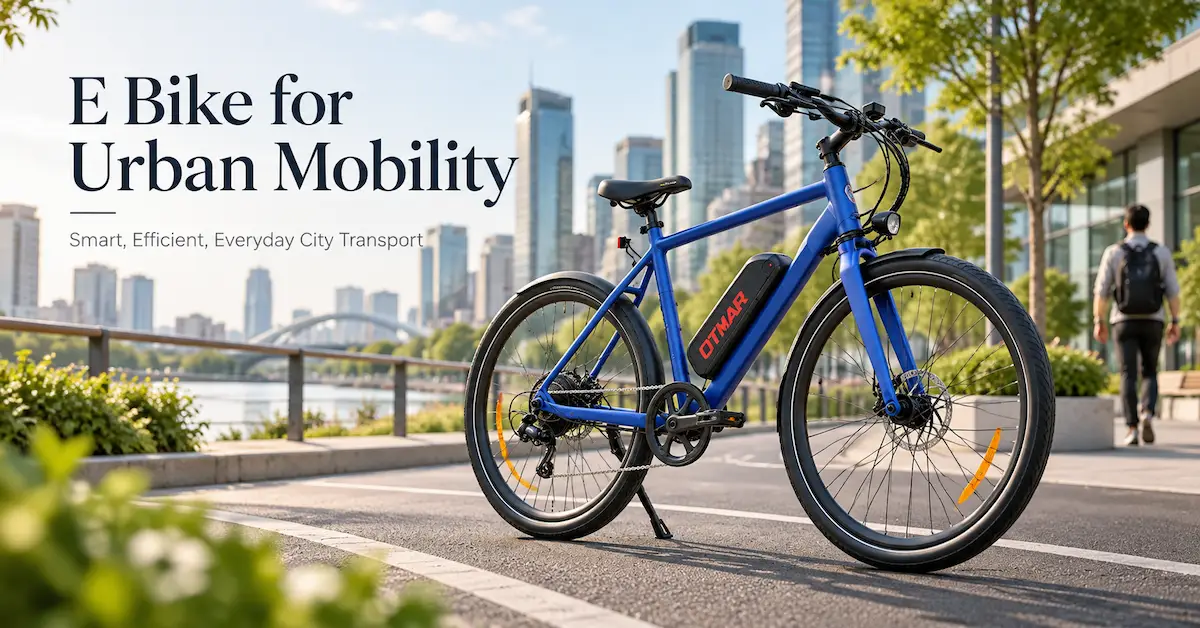
An integrated or hidden battery can provide a cleaner frame design and centralized packaging. OTMAR's current OTM-M9 product page, for example, describes a 26-inch city bike with a 500W rear-drive system and a hidden Samsung battery.
A removable battery may be more convenient when:
- The rider cannot charge beside the bike
- Apartments restrict bike storage
- Employers provide indoor charging
- Fleet batteries are managed centrally
For battery safety, the U.S. Consumer Product Safety Commission recommends using the charger provided or recommended by the manufacturer and using only replacement battery packs confirmed as suitable for the device. See the CPSC Micromobility Information Center.
Is a 500W Motor Enough for Daily Commuting?
Motor wattage alone does not determine whether an electric bike is suitable for commuting.
Buyers should consider the complete drive system:
- Motor type
- Rated power
- Torque
- Controller
- Battery voltage
- Wheel size
- Bike weight
- Rider weight
- Hill gradient
- Legal limits
For relatively flat urban travel, a moderate-power rear-hub configuration may provide sufficient assistance while keeping the product focused on practical city riding.
Where routes include steep hills or heavier loads, another configuration may be appropriate. The important point is that more wattage is not automatically better.
A higher-power specification may also create regulatory issues in some target markets, which makes destination-market compliance part of product selection.
Comfort Matters More Than Many Buyers Expect
A commuter may ride the same bike five days a week.
Small ergonomic problems that seem minor during a five-minute showroom test can become significant during repeated 30- or 60-minute rides.
Frame Geometry
Commuter geometry should support:
- Stable steering
- Comfortable reach
- Practical mounting
- Good low-speed control
- Predictable body position
Step-through frames can be especially useful for riders who frequently stop in traffic, carry work clothing, or prefer easier mounting.
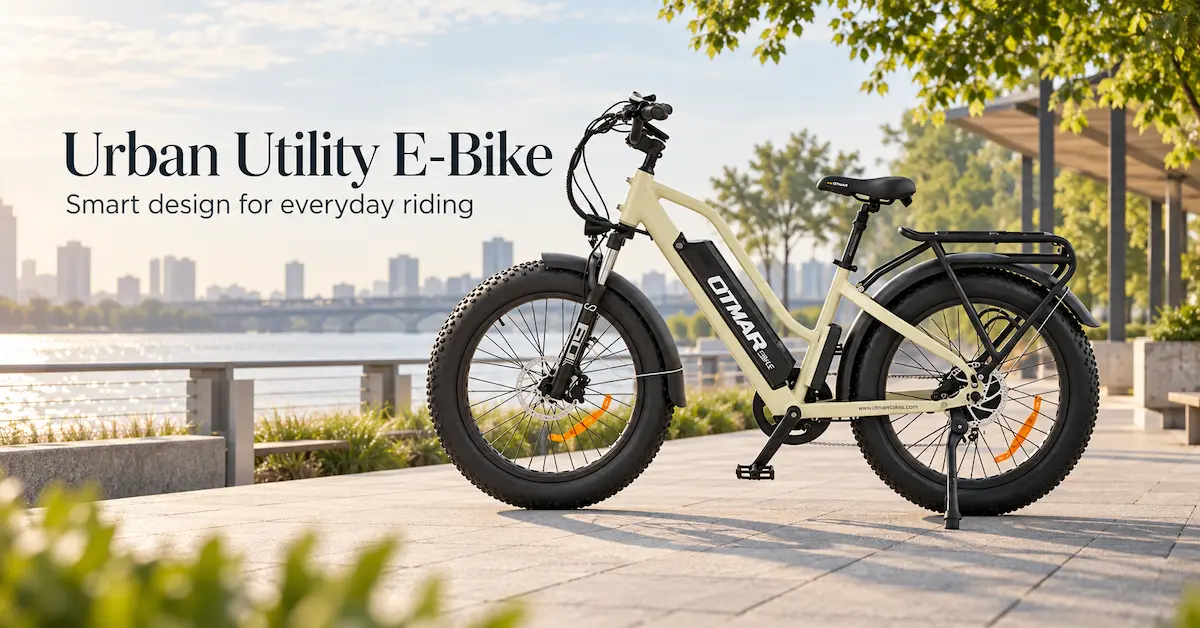
The current OTM-Q20 page describes a step-through structure together with dual suspension, wide tires, an integrated battery, lights, disc brakes, and a rear rack, making it a relevant platform to evaluate for comfort-oriented urban applications.
Saddle and Handlebar Position
A commuter should not need an aggressive riding posture unless that is intentionally part of the product positioning.
OTMAR's OTM-M9 currently lists an ergonomic saddle and adjustable handlebars in addition to its city-oriented drivetrain.
For an OEM project, buyers should still confirm:
- Rider height range
- Seat adjustment
- Handlebar adjustment
- Reach
- Pedal position
during sample testing.
What Everyday Equipment Should a Commuter E Bike Have?
A good daily commuter becomes more useful when routine accessories are designed into the bike rather than added as an afterthought.
Rear Rack
A rear rack can carry:
- Work bag
- Laptop pannier
- Groceries
- Gym equipment
- Small personal items
OTMAR's OTM-C1 product page currently includes a rear rack as part of its city-oriented equipment.
Fenders
For commuting, fenders can be more valuable than performance-oriented accessories because riders often need to arrive at work in normal clothing.
The OTM-C1 page also lists integrated fenders.
Lighting
Commuters may ride:
- Before sunrise
- After work
- In overcast conditions
- Through shaded urban streets
Front and rear lighting should therefore be evaluated during product specification and sample inspection.
Kickstand and Parking Practicality
A commuter bike is parked frequently.
Buyers should consider:
- Bike stability when parked
- Rack load
- Parking space
- Locking points
- Battery security
These factors may not attract attention in product advertising, but they directly affect everyday usability.
Braking and Tires Should Match Urban Conditions
Daily city travel normally involves more braking events than recreational open-road riding.
Traffic lights, intersections, pedestrians, parked vehicles, driveways, and frequent starts make predictable control important.
OTMAR's current OTM-M9, OTM-C1, and OTM-Q20 pages all describe disc-brake configurations.
For B2B purchasing, however, the brake label itself is only the beginning.
A sample should be evaluated for:
- Lever feel
- Low-speed control
- Loaded braking
- Repeated braking
- Rotor alignment
- Service access
- Replacement-part availability
Do Commuters Need Fat Tires?
Not necessarily.
Fat or wide tires can improve comfort or confidence on poor surfaces, but they may not be the most efficient choice for every urban rider.
Tire selection should consider:
| Commuting Environment | Tire Priority |
|---|---|
| Smooth bike lanes | Rolling efficiency |
| Broken pavement | Comfort and impact absorption |
| Wet streets | Predictable grip |
| Mixed pavement and gravel | Versatility |
| Poor urban roads | Stability and durability |
| Seasonal rough conditions | Surface-specific traction |
A commuter bike should be optimized for its expected road network rather than selected for visual impact alone.
OTM-M9 vs OTM-C1 vs OTM-Q20 for Daily Commuting
OTMAR currently has several city-oriented platforms that can be considered for daily-use projects.
| Model | Published Characteristics | Potential Commuter Positioning | Buyer Should Confirm |
| OTM-M9 | 26", 500W rear drive, Samsung hidden battery, disc brakes, ergonomic saddle, adjustable handlebars | Everyday urban commuting and comfort | Battery capacity, tested range, rider-size fit |
| OTM-C1 | 26", 500W rear drive, Samsung battery, aluminum frame, rear rack, fenders, disc brakes | Practical commuter with utility equipment | Battery capacity, rack rating, tested range |
| OTM-Q20 | Step-through frame, integrated battery, dual suspension, wide tires, lights, disc brakes, rear rack | Comfort-oriented and mixed-road commuting | Motor/battery specification, weight, tested range |
The comparison is based on features currently published on OTMAR's product pages. It should not be interpreted as a claim about unlisted specifications such as certified range, maximum payload, battery capacity, waterproof rating, or exact rider-size limits.
When OTM-M9 Makes Sense
The OTM-M9 is worth evaluating when a buyer wants a straightforward city platform centered on commuting comfort and a hidden-battery appearance.
When OTM-C1 Makes Sense
The OTM-C1 may be particularly relevant where practical commuting accessories matter because its published configuration includes a rear rack and fenders in addition to the 500W rear-drive system.
When OTM-Q20 Makes Sense
The OTM-Q20 can be considered where easier mounting, wider tires, suspension, and urban comfort are important purchasing criteria.
How to Test an E Bike for Daily Commuting Before Bulk Ordering
B2B buyers should avoid approving a commuter model from a specification sheet alone.
Test the Real Commute
Create a route that includes:
- Flat road
- Stop-and-go traffic
- Hill starts if relevant
- Turns
- Rough pavement
- Parking
- Typical cargo
Measure battery use and rider comfort rather than relying only on a laboratory-style continuous ride.
Test Different Riders
If the product is intended for retail or fleet use, ask riders of different heights to evaluate:
- Mounting
- Saddle adjustment
- Handlebar reach
- Low-speed control
- Starting
- Stopping
Test the Bike With Everyday Cargo
Add:
- Backpack
- Panniers
- Work bag
- Groceries
Then check handling and parking stability.
Inspect Maintenance Access
A technically strong commuter bike can still create after-sales problems if common components are difficult to replace.
Inspect:
- Tires
- Brake components
- Chain
- Controller access
- Wiring
- Display
- Battery removal
- Charger
- Lights
Battery and Electrical Safety Should Be Part of the Buying Decision
For daily-use electric bikes, the battery, charger, drive system, and electrical architecture should be treated as a complete system.
UL Solutions explains that UL 2849 evaluates the electrical drive train, battery system, and charger system combinations used in e-bikes.
The same UL resource also distinguishes other standards and requirements that may apply depending on the target market. For example, it discusses EN 15194 in the European context.
For importers and private-label buyers, the practical lesson is simple:
Determine the target market before freezing the specification.
Do not assume that changing the motor, battery, charger, or electrical configuration has no effect on compliance requirements.
OTMAR's About Us page states that the company works as an OEM/ODM manufacturer and references EN 15194, UL, CE, UKCA, and ISO 9001 among its broader certification capabilities. These statements should not be interpreted as proof that every current model or every customized configuration carries every certification; model-specific documentation should be confirmed during sourcing.
What Should B2B Buyers Consider in an OEM Commuter E Bike?
A successful private-label commuter does not need every available feature. It needs the right configuration for a defined customer.
Product Positioning
First define:
- Target country
- Retail price level
- Rider profile
- Typical commute length
- Terrain
- Sales channel
- Service model
Technical Configuration
Then evaluate:
- Frame style
- Wheel size
- Motor system
- Battery
- Controller
- Display
- Sensor
- Brakes
- Tires
- Lighting
- Rack
- Fenders
Branding and Presentation
A private-label program may also require:
- Logo
- Frame color
- Decals
- Model label
- User manual
- Packaging
- Shipping marks
OTMAR describes itself as an OEM/ODM manufacturer of electric mobility products and presents engineering, manufacturing, testing, and technical support as parts of its B2B offering.
Buyers interested in customization can review the OTMAR electric bike range before discussing the final configuration.
Daily Commuter E Bike Cost: Compare Total Value, Not Only Unit Price
The cheapest quotation is not always the lowest-cost commuter program.
Commercial buyers should consider:
| Cost Factor | Why It Matters |
| Bike price | Initial procurement cost |
| Battery | One of the most important long-term replacement items |
| Charger | Must match the electrical system |
| Brake parts | Regular service requirement |
| Tires | Wear depends on road conditions and mileage |
| Spare parts | Determines repair speed |
| Packaging | Affects international shipping protection |
| Assembly | Influences dealer or end-user setup |
| Warranty support | Influences after-sales cost |
| Downtime | Important for fleets and rentals |
A slightly higher purchase price can make commercial sense if it gives the buyer a more standardized product, easier maintenance, better spare-parts planning, and fewer avoidable after-sales issues.
Daily Commuting E Bike Procurement Checklist
Before requesting a quotation, prepare the following information:
- Target country
- Expected order quantity
- Target retail or market position
- Typical one-way commute distance
- Flat, hilly, or mixed terrain
- Typical rider profile
- Required motor configuration
- Battery and charging requirements
- Frame preference
- Tire type
- Rack requirements
- Fender requirements
- Lighting requirements
- Branding
- Packaging
- Required certifications or test reports
- Spare-parts plan
- Sample-testing requirements
This information allows a manufacturer to recommend a configuration based on actual use instead of sending a generic catalog quotation.
To discuss a project, buyers can review OTMAR's company background, browse its City eBike collection, or contact OTMAR with target-market and specification requirements.
FAQ About E Bike for Daily Commuting
What is the best e bike for daily commuting?
The best commuter e-bike is the one matched to commute distance, terrain, rider size, carrying requirements, comfort expectations, maintenance needs, and local regulations. There is no single specification that is best for every rider.
How much range should a commuter e-bike have?
The required range should comfortably cover the complete daily route plus an operating reserve. Buyers should verify it through representative route testing because rider weight, hills, temperature, speed, assistance level, wind, and tire pressure can affect energy consumption.
Is a 500W e-bike suitable for commuting?
A 500W system can be appropriate for many commuting applications, but suitability depends on torque, controller setup, wheel size, rider load, terrain, and local regulations. Motor wattage should not be evaluated alone.
Is a step-through e-bike good for daily commuting?
A step-through frame can be convenient for frequent stops, riders in work clothing, and users who prefer easier mounting and dismounting. Buyers should still evaluate frame geometry and handling during sample testing.
Do I need suspension on a commuter e-bike?
Not always. Suspension can improve comfort on uneven roads, but smooth urban routes may not require a complex suspension system. Tire size, tire pressure, frame geometry, and saddle comfort also affect ride quality.
What is better for commuting, a hidden or removable battery?
Neither design is universally better. Hidden batteries can provide cleaner integration, while easily removable batteries may be more convenient where the bike cannot be brought to a charging point. The best option depends on the user's storage and charging environment.
Should a commuter e-bike have a rear rack?
A rear rack is useful for riders carrying a work bag, groceries, panniers, or everyday equipment. Buyers should confirm rack compatibility and rated loading requirements for the final model rather than assuming every rack supports the same load.
What safety standards should an e-bike buyer check?
Requirements depend on the destination market and final configuration. UL 2849 addresses e-bike electrical systems in relevant North American contexts, while European projects may need to consider EN 15194 and other applicable requirements. Buyers should verify the exact regulatory path for their market.
Which OTMAR models can be considered for daily commuting?
OTM-M9, OTM-C1, and OTM-Q20 are current city-oriented platforms worth evaluating. Their published features emphasize different combinations of city geometry, comfort, rack equipment, suspension, and battery integration. Final specifications should be confirmed before procurement.
Can OTMAR customize commuter e-bikes for private-label brands?
OTMAR identifies itself as an OEM/ODM electric-mobility manufacturer. Buyers can discuss branding and configuration requirements based on their target market, but final customization feasibility, specifications, certifications, MOQ, and lead time should be confirmed for each project.
Conclusion
Choosing an e bike for daily commuting starts with understanding the commute itself.
Distance, hills, traffic, rider comfort, carrying needs, charging access, maintenance, and market regulations should determine the specification. Motor wattage or advertised battery range alone cannot tell a buyer whether a bike will perform well in everyday use.
For B2B buyers, the strongest commuter product is usually one that delivers a balanced combination of reliable assistance, practical battery management, comfortable geometry, predictable braking, useful everyday equipment, and straightforward serviceability.
OTMAR offers city-oriented electric-bike platforms for distributors, retailers, private-label brands, and other B2B projects. Explore the OTMAR City eBike range or contact OTMAR with your target country, commute scenario, quantity, and desired configuration to begin a product and sample discussion.