
An e bike for food delivery is a commercial working vehicle, not simply a commuter bicycle fitted with a delivery box. It may operate through repeated starts, short urban routes, frequent braking, changing payloads, long working shifts, and continuous charging cycles. Those conditions make battery strategy, cargo stability, braking performance, component durability, and maintenance accessibility more important than headline specifications alone. OTMAR's existing delivery-bike guidance similarly emphasizes that commercial delivery use requires stronger structural design, reliable electrical systems, practical cargo solutions, and fleet-oriented maintenance planning.
For a fleet operator, restaurant group, distributor, or private-label brand, the right question is therefore not simply:
Which e-bike has the most power?
The more useful question is:
Which configuration can complete the required delivery routes repeatedly, carry the intended food box safely, remain easy to service, and meet the requirements of the destination market?
Buyers evaluating a project can start by reviewing the current OTMAR electric bike range and then match the platform to actual route conditions rather than selecting a bike only from catalog specifications. OTMAR currently lists city, touring, cargo, gravel, hybrid and other electric-bike categories on its product structure.
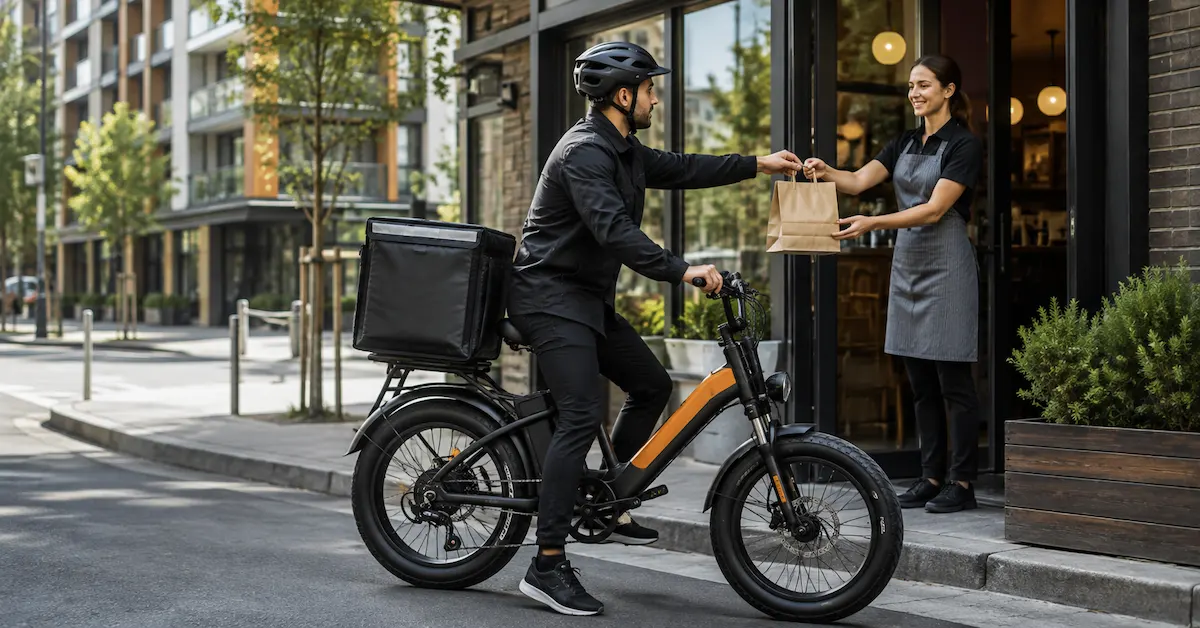
Who Needs Food Delivery E Bikes?
The keyword “food delivery e bike” covers several very different commercial buyers.
Restaurant Chains and Food Brands
Restaurants operating their own delivery service may prioritize:
- Consistent vehicle appearance
- Branded delivery boxes
- Short urban routes
- Easy rider training
- Reliable batteries
- Low maintenance complexity
- Standardized spare parts
The vehicle becomes part of the restaurant's operating system and brand presentation, so fleet consistency can matter more than maximum performance.
Delivery Fleet Operators
Fleet businesses normally need to think beyond a single rider.
Important purchasing questions include:
- How many kilometers does each shift cover?
- How many orders are carried per shift?
- Is battery swapping possible?
- How quickly can worn parts be replaced?
- Can one standardized configuration serve most riders?
- Are replacement batteries, chargers, controllers and brake components available?
OTMAR's broader commercial-delivery guidance identifies battery replacement, fleet consistency, spare-parts availability and operating efficiency as important concerns for commercial buyers.
Distributors and Wholesalers
A distributor sourcing an e bike for food delivery has another concern: the bike must work for more than one end customer.
They should therefore evaluate:
- Local delivery habits
- Local road conditions
- Motor regulations
- Typical rider size
- Common delivery-box formats
- Service-network capabilities
- Replacement-part requirements
Private Label E-Bike Brands
Private-label buyers may need a complete commercial product program rather than an off-the-shelf bicycle.
That can include:
- Brand logo
- Frame color
- Model naming
- Battery configuration
- Motor configuration
- Display
- Tires
- Lighting
- Rack or cargo interface
- Packaging
- User manual
- Fleet identification
OTMAR describes OEM/ODM cooperation as covering product selection, configuration planning, branding, sample development, inspection and production support.
8 Factors That Determine the Best E Bike for Food Delivery
1. Battery Capacity Should Follow the Delivery Route
Battery selection should begin with the duty cycle rather than an advertised range number.
Real operating demand changes with:
- Route distance
- Rider weight
- Food cargo weight
- Number of starts and stops
- Assistance level
- Average speed
- Hills
- Temperature
- Tire pressure
- Traffic
- Road surface
OTMAR's delivery guidance specifically notes that cargo weight, delivery frequency, road conditions, riding speed and assistance mode affect practical range expectations.
A useful fleet-planning approach is:
Required battery energy ≈ tested energy consumption per kilometer × expected route distance × operating reserve
The important word is tested. Instead of relying only on theoretical range, ask the supplier to configure a sample and run it with the actual rider weight, delivery box and representative route.
Removable Batteries Can Improve Fleet Flexibility
For multi-shift operations, buyers should also evaluate whether batteries can be removed and exchanged efficiently.
A battery-swapping strategy can reduce dependence on waiting for the entire bicycle to recharge, but the replacement pack must be designed and approved for the specific electrical system.
The U.S. Consumer Product Safety Commission advises users to use only replacement battery packs confirmed as suitable for the device by the manufacturer and warns against modified packs or batteries rebuilt with repurposed cells. See the CPSC Micromobility Information Center.
2. Motor Power Is Only Part of Delivery Performance
For food delivery, a larger motor number does not automatically mean a better vehicle.
The drive system should be evaluated as a combination of:
- Rated motor power
- Torque
- Controller current
- Battery voltage
- Wheel diameter
- Total loaded weight
- Hill conditions
- Start-stop frequency
- Local regulations
A delivery rider who constantly restarts at intersections may care more about predictable low-speed response and hill-start capability than maximum speed.
This is particularly important for B2B buyers comparing 500W and 750W platforms. The correct choice depends on the operating environment and applicable market rules, not simply which number looks stronger in a product listing.
3. Cargo Position Can Change the Entire Riding Experience
Food delivery creates a unique cargo requirement because the load should remain stable while the rider accelerates, brakes and turns.
Common systems include:
- Rear delivery rack
- Insulated food box
- Lockable delivery box
- Side bags
- Front basket
- Custom cargo platform
A larger box is not automatically better.
Buyers should check:
- Box dimensions
- Mounting points
- Rack compatibility
- Loaded center of gravity
- Heel clearance
- Rider access
- Box removal
- Maintenance access
OTMAR's delivery-manufacturer guide identifies rear racks, front boxes, insulated containers, lockable storage and custom cargo platforms as potential commercial configurations.
Food Delivery vs General Cargo Delivery
| Application | Main Cargo Priority | Vehicle Priority |
|---|---|---|
| Restaurant meals | Insulated box stability | Smooth handling |
| Grocery delivery | Larger variable load | Rack strength |
| Beverage delivery | Stable heavy cargo | Braking and balance |
| Fast-food delivery | Frequent stops | Easy acceleration |
| Multi-order delivery | Organized storage | Cargo accessibility |
| Long-route delivery | Moderate cargo | Battery management |
Food delivery therefore requires a different specification discussion from parcel logistics.
4. Brakes Must Be Evaluated Under Load
A delivery bicycle repeatedly accelerates and stops while carrying additional weight.
That means buyers should evaluate:
- Brake type
- Brake response
- Brake wear
- Rotor condition
- Lever feel
- Loaded stopping behavior
- Ease of replacing service parts
OTMAR's current OTM-C1, OTM-M9 and OTM-K6 product pages all describe disc-brake systems.
However, a catalog statement such as “disc brakes” is not enough for a fleet purchasing decision. The sample should be tested with the intended rider and delivery load.
5. Tires Should Match the Delivery Environment
Tire selection influences:
- Grip
- Rolling resistance
- Comfort
- Stability
- Puncture exposure
- Replacement cost
- Battery consumption
For mostly paved downtown delivery, a conventional city-oriented tire may be more practical than an oversized fat tire.
For poor pavement, mixed surfaces, gravel access roads or less-developed delivery areas, wider tires and suspension may improve control and comfort.
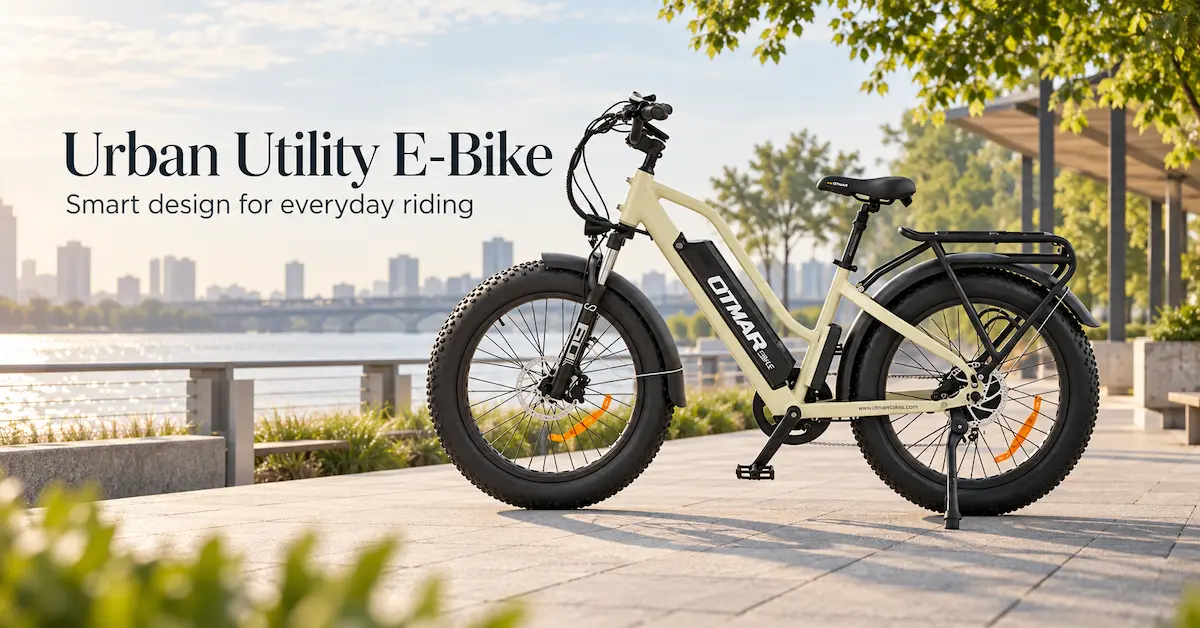
The OTM-K6, for example, is currently described by OTMAR as a 24-inch platform with a 750W rear motor, Samsung battery, all-terrain fat tires, front suspension, disc brakes and a rear rack.
The correct tire should therefore follow the route rather than appearance.
6. Rider Comfort Affects Long Working Shifts
Comfort becomes a commercial factor when riders spend hours on the bicycle.
Important details include:
- Saddle design
- Handlebar position
- Frame geometry
- Step-over height
- Suspension
- Grip position
- Rider sizing
An uncomfortable bicycle can be technically capable but poorly suited to a delivery fleet.
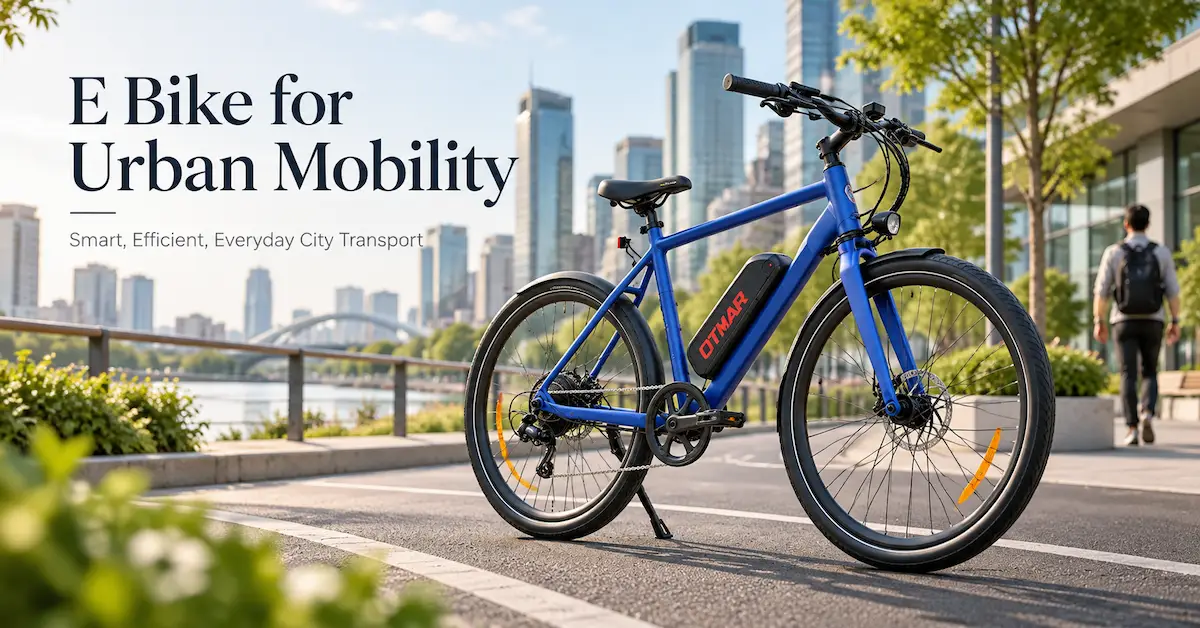
OTMAR's OTM-M9 is currently described as a 26-inch city e-bike with a 500W rear-drive system, Samsung hidden battery, disc brakes, ergonomic saddle and adjustable handlebars, making it a useful city platform to evaluate where rider comfort is a major project requirement.
Which OTMAR Platforms Are Worth Evaluating?
OTMAR does not currently publish enough verified information for us to state that one model is a dedicated food-delivery SKU with a confirmed payload, range or delivery-box rating.
However, several existing electric bike models provide useful starting platforms for project evaluation.
| OTMAR Model | Published Features | Potential Delivery Fit | Buyer Must Confirm |
|---|---|---|---|
| OTM-C1 | 26", 500W rear drive, Samsung battery, aluminum frame, rear rack, disc brakes, fenders | Urban restaurant and local delivery | Payload, battery capacity, box interface, range |
| OTM-M9 | 26", 500W rear drive, Samsung hidden battery, disc brakes, ergonomic saddle, adjustable handlebars | Urban riders prioritizing comfort | Cargo interface, payload, range |
| OTM-K6 | 24", 750W rear drive, Samsung battery, fat tires, front suspension, disc brakes, rear rack | Mixed roads, uneven surfaces or hillier routes | Market legality, payload, battery capacity, range |
The OTM-C1 is particularly relevant as an initial urban-delivery platform because its published specification includes an aluminum frame, rear rack, fenders and disc brakes together with a 500W rear-drive system.
The OTM-K6 may be worth evaluating for more demanding surfaces because OTMAR lists fat tires and front suspension in addition to its rear rack and 750W rear motor.
For delivery fleets focused heavily on rider ergonomics, the OTM-M9 provides another city-oriented platform for sample evaluation.
Important: these are platform recommendations for evaluation, not claims about verified delivery payload, real-world range, waterproof rating or regulatory approval. Those items should be confirmed for the final project configuration before ordering.
How to Test an E Bike for Food Delivery Before Bulk Ordering
Skipping sample testing is one of the biggest avoidable risks in commercial sourcing.
A useful test should reproduce the intended delivery environment.
Loaded Route Test
Install the intended cargo box and simulate realistic food weight.
Check:
- Starting behavior
- Low-speed handling
- Turning
- Hill starts
- Rider balance
- Rack movement
- Frame behavior
Battery Duty-Cycle Test
Do not test only one continuous ride.
Food delivery normally involves repeated:
Ride → stop → restart → accelerate → brake → wait → restart
Record energy consumption under that pattern.
Brake Test
Evaluate:
- Unloaded braking
- Loaded braking
- Repeated braking
- Downhill braking where applicable
- Brake feel after repeated use
Cargo Stability Test
The box should remain stable during:
- Turning
- Braking
- Road bumps
- Mounting and dismounting
- Parking
Maintenance Test
Ask a technician to remove and replace common service parts.
This reveals whether the bike will be convenient to maintain once deployed across dozens or hundreds of units.
OTMAR's existing commercial-delivery guidance similarly recommends testing loaded riding, braking, battery endurance, cargo stability and maintenance convenience before fleet purchasing.
Battery and Electrical Safety Should Be a Procurement Requirement
Battery safety deserves special attention in a vehicle used frequently and recharged often.
UL Solutions explains that UL 2849 evaluates the e-bike electrical system, including the relationship between the electrical drive train, battery and charger, while UL 2271 addresses batteries used in light electric vehicle applications. Buyers can review the official UL 2849 e-bike certification information.
CPSC also recommends using the supplied charger and only approved replacement battery packs, and advises against battery packs modified by unqualified personnel.
For an international B2B project, this means the buyer should confirm the requirements of the destination market and final vehicle configuration before sample approval and mass production.
European buyers can also review OTMAR's internal guide to EN 15194 requirements for electric bikes. OTMAR itself notes that certification and documentation requirements depend on destination market and product configuration.
OEM Customization for Food Delivery Fleets
A standardized commuter bike may work for a small independent rider, but larger commercial programs often need configuration control.
OTMAR's OEM/ODM framework can support project discussions around product selection, configuration, branding, sample development, inspection and export communication.
Branding Options
A food-delivery project may require:
- Frame logo
- Fleet color
- Model label
- Delivery-box branding
- Serial or fleet identification
- Custom manual
- Packaging
- Carton marks
Technical Configuration
Depending on project feasibility, buyers may discuss:
- Motor specification
- Battery configuration
- Display
- Tires
- Lighting
- Rack
- Cargo-box interface
- Accessories
Fleet Standardization
This is often more valuable than adding unnecessary options.
A standardized fleet can simplify:
- Rider training
- Spare-parts inventory
- Battery management
- Troubleshooting
- Maintenance
- Repeat purchasing
For a broader supplier-selection discussion, see OTMAR's Electric Delivery Bike Manufacturer Guide. That page focuses on manufacturer evaluation, while this guide focuses specifically on configuring an e bike for food delivery operations.
Food Delivery E Bike Cost: Look Beyond the Purchase Price
The lowest initial quotation does not necessarily produce the lowest fleet operating cost.
A B2B buyer should evaluate total ownership factors such as:
| Cost Area | Questions to Ask |
|---|---|
| Initial bike | What configuration is included? |
| Battery | How are replacements supplied? |
| Charger | Is the charger matched to the system? |
| Tires | Are replacements locally available? |
| Brakes | How frequently are service components checked? |
| Cargo box | Is the mounting system standardized? |
| Spare parts | Which parts should be stocked? |
| Labor | How easy is routine maintenance? |
| Downtime | How quickly can a disabled bike return to service? |
| Logistics | Is packaging designed for international shipping? |
For a food-delivery fleet, a slightly more expensive standardized platform may create better commercial value if it reduces maintenance complexity and operational downtime.
Buyer Checklist Before Requesting a Quotation
Before contacting an e-bike manufacturer, prepare:
- Target country or market
- Number of bikes required
- Restaurant, platform or fleet application
- Expected daily route distance
- Maximum rider weight
- Expected food cargo weight
- Delivery-box dimensions
- Road conditions
- Hill conditions
- Desired motor configuration
- Battery and charging strategy
- Required rack or cargo system
- Tire preference
- Branding requirements
- Packaging requirements
- Applicable certification requirements
- Spare-parts requirements
- Sample-testing plan
Providing this information allows the manufacturer to evaluate the complete operating scenario instead of quoting a generic bicycle.
Buyers can review OTMAR's company background, compare the electric bike range, or contact OTMAR with the intended route, quantity, cargo requirement and target market. OTMAR's contact page specifically invites cooperation with wholesalers, distributors and brands.
FAQ About E Bike for Food Delivery
What is the best e bike for food delivery?
The best configuration is the one matched to the real route. Buyers should evaluate battery capacity, loaded weight, cargo-box position, motor and controller behavior, braking, tires, comfort, maintenance and local regulations rather than selecting only by motor wattage.
How much battery range does a food delivery e-bike need?
There is no universal range requirement. Determine the expected route distance and measure energy consumption using a loaded sample under realistic stop-and-go conditions, then include an operating reserve.
Is a 500W or 750W motor better for food delivery?
Neither is automatically better. A 500W system may suit many urban applications, while higher-power configurations can be relevant to heavier loads or more demanding terrain. The complete motor, controller, battery, wheel and payload system should be considered together, as should local regulations.
Does a delivery e-bike need a removable battery?
Not always, but removable batteries can be useful for businesses operating multiple shifts or centralized charging programs. Any replacement battery should be specifically compatible with the vehicle's electrical system. CPSC advises using approved, manufacturer-compatible replacement packs.
Is a rear rack enough for food delivery?
It depends on the delivery-box size, load and mounting system. The rack and attachment points should be evaluated under realistic cargo loads, braking and cornering before fleet deployment.
Are fat tires better for delivery riders?
Fat tires can offer advantages on rough or mixed surfaces, but they are not automatically the best solution for every city fleet. Tire width should be selected according to road conditions, stability, rolling efficiency, service availability and the overall vehicle design.
Which OTMAR model is suitable for food delivery?
The OTM-C1, OTM-M9 and OTM-K6 are current platforms worth evaluating depending on route conditions. OTM-C1 includes a rear rack, fenders and disc brakes; K6 combines a rear rack with fat tires and front suspension; M9 emphasizes city-oriented comfort. Final payload, range, box compatibility and regulatory requirements still need project-specific confirmation.
Can food delivery e-bikes be customized with a company logo?
Yes, OEM/ODM programs can include branding and configuration discussions. OTMAR describes support for product selection, branding, configuration planning, samples, production and inspection for B2B projects.
What should a fleet test before placing a bulk order?
Test loaded handling, actual route energy consumption, hill starts, braking, cargo stability, rider comfort and routine maintenance. The goal is to validate the complete duty cycle rather than one isolated specification.
What certifications should delivery e-bike buyers check?
Requirements vary by destination market and final configuration. Buyers should identify applicable vehicle, electrical-system and battery requirements before sample approval. UL 2849 and UL 2271 are important references in relevant U.S. safety contexts, while European projects may need to evaluate EN 15194 and other applicable requirements.
Conclusion
Choosing an e bike for food delivery should begin with the delivery operation—not the catalog.
A commercial buyer needs to understand route distance, cargo weight, road conditions, rider hours, charging strategy and maintenance capabilities before deciding on motor power, battery configuration, tires or cargo equipment.
For fleet buyers, the strongest specification is usually the one that provides repeatable daily operation, safe cargo handling, predictable maintenance and standardized spare-parts support, rather than the bike with the largest advertised numbers.
OTMAR provides electric-bike OEM/ODM solutions for distributors, wholesalers, brands and commercial mobility projects. Explore the OTMAR electric bike range or contact OTMAR with your target market, fleet quantity, route conditions, delivery-box requirements and preferred configuration to begin a sample and sourcing discussion.