
What Makes an Electric Trike Suitable for Commercial Use?
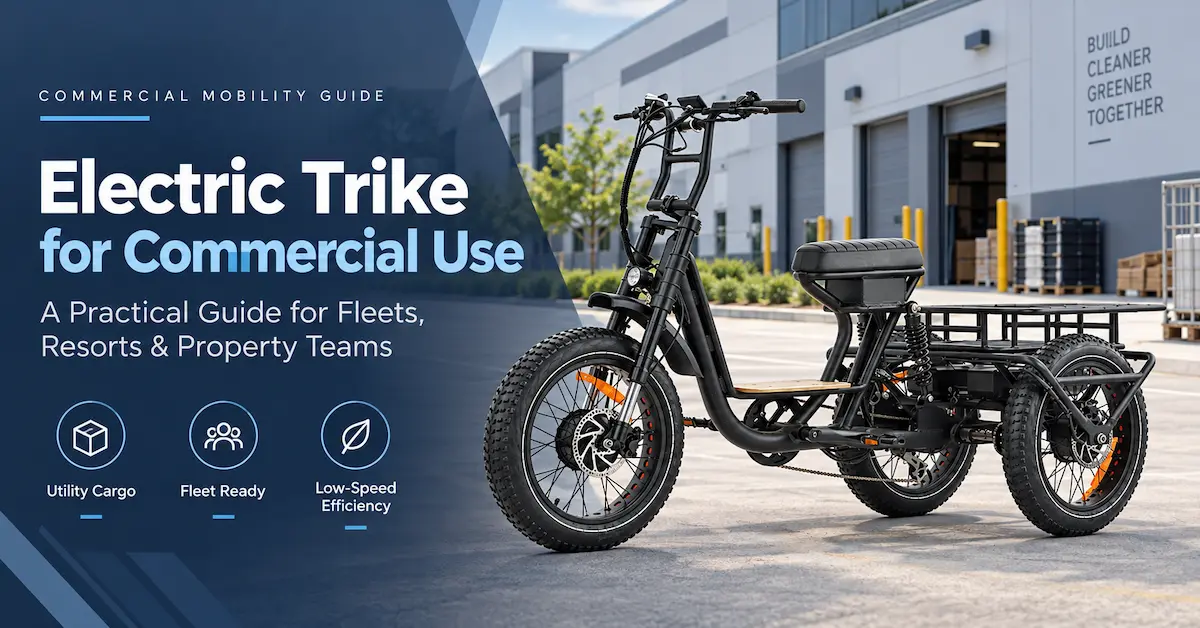
An electric trike for commercial use should be treated as an operating asset, not simply as a consumer bicycle with an extra wheel.
The correct vehicle must fit a defined task, complete that task consistently, remain practical to charge and service, and support predictable fleet operation over repeated working days. Motor power and battery size matter, but they do not determine commercial suitability on their own.
A commercial buyer should evaluate the complete operating system:
- Who will ride the vehicle?
- What work must it complete?
- What load or equipment will it carry?
- How long is each route?
- How often will it stop and restart?
- How many shifts will it operate?
- Where will it be parked and charged?
- Who will inspect and maintain it?
- Which parts must be kept in stock?
- What market and site rules apply?
A trike used by a hotel maintenance team has different requirements from one used by a campus security department. A property-management vehicle carrying tools does not have the same duty cycle as a tourism rental trike. A warehouse vehicle may operate over short distances but make frequent stops throughout the day, while a resort vehicle may travel longer routes with lighter loads.
The value of a commercial electric trike therefore comes from task fit, uptime, serviceability, and operating consistency.
Buyers can begin by reviewing the current electric trike product range, but the final decision should be based on the real application rather than a catalog image or a single headline specification.
Commercial Electric Trike vs Consumer Electric Trike
A consumer normally evaluates a trike through personal preference. The decision may focus on comfort, appearance, range, storage, and occasional utility.
A commercial operator has a different responsibility. The vehicle must work within a process involving multiple riders, scheduled tasks, supervisors, charging locations, maintenance procedures, spare parts, and operating budgets.
| Evaluation Area | Consumer Use | Commercial Use |
|---|---|---|
| Main objective | Personal transport or recreation | Complete a repeatable business task |
| Rider profile | Usually one primary rider | Multiple employees or rotating riders |
| Daily use | Variable or occasional | Scheduled, repeated, and measurable |
| Load | Personal belongings or shopping | Tools, supplies, equipment, or operational cargo |
| Charging | Based on personal convenience | Must fit shifts, storage, and fleet workflow |
| Maintenance | Reactive or owner-managed | Planned inspections and controlled service |
| Downtime impact | Inconvenience to one rider | Can interrupt operations or require backup vehicles |
| Parts planning | Purchased when needed | Critical parts should be identified in advance |
| Product changes | Usually limited impact | Can affect training, maintenance, and fleet consistency |
| Success measure | Rider satisfaction | Uptime, task completion, cost, safety, and efficiency |
A vehicle may perform well for an individual yet still be unsuitable for a commercial fleet.
For example, a complex control system may appeal to a private owner but create unnecessary training for rotating staff. A highly customized component may look distinctive but be difficult to replace. A large cargo platform may provide useful capacity but prevent the vehicle from entering a storage room or turning inside a narrow service route.
Commercial selection must balance performance with operational simplicity.
Where Can Electric Trikes Create Commercial Value?
The phrase “commercial use” covers several very different applications. Buyers should avoid treating all commercial projects as one category.
Hotels and Resorts
Hotels and resorts may use electric trikes for:
- Property inspections
- Housekeeping support
- Transporting linens or light supplies
- Maintenance movement
- Guest-service support
- Moving equipment between buildings
- Internal staff transportation
In these environments, low-speed control, rider access, quiet operation, cargo organization, appearance, and easy charging may be more important than maximum speed.
A resort may also have multiple rider types. A maintenance employee may use the vehicle in the morning, while another department uses it later in the day. Controls should therefore be intuitive, and the vehicle should not require extensive individual adjustment before every shift.
The operating route also matters. Buyers should record whether the property includes paved paths, ramps, gravel sections, narrow passages, guest areas, service corridors, or wet surfaces.
Campuses and Educational Facilities
Universities, schools, corporate campuses, and research parks often have long internal routes that are too far for efficient walking but do not justify a conventional vehicle for every task.
Possible applications include:
- Maintenance inspections
- Security patrol
- Mail and document movement
- Facilities support
- Event preparation
- Equipment transport
- Groundskeeping support
Campus buyers should focus on turning space, pedestrian interaction, braking, visibility, parking, rider training, and the ability to carry frequently used equipment.
A campus fleet may also need standardized colors, identification labels, numbered vehicles, department markings, and consistent replacement parts.
Property Management and Residential Communities
Property managers may use commercial electric trikes for:
- Carrying tools
- Transporting cleaning supplies
- Inspecting buildings
- Moving between residential blocks
- Supporting landscaping teams
- Delivering notices or small items
- Responding to maintenance requests
These applications often involve frequent stops, short routes, repeated mounting and dismounting, and mixed riders.
A step-through frame may be useful because employees regularly enter and exit the vehicle. A secure cargo compartment may be more valuable than a very large open rack if tools need protection or organization.
Warehouses, Factories, and Large Facilities
Large industrial or logistics sites may use electric trikes for internal transport between production areas, storage zones, offices, and service points.
A factory or warehouse project should examine:
- Aisle width
- Turning radius
- Floor surface
- Pedestrian interaction
- Storage location
- Indoor charging rules
- Cargo dimensions
- Shift length
- Vehicle visibility
- Maintenance responsibility
High speed is rarely the main objective inside a facility. Predictable control, reliable braking, compact dimensions, low-speed maneuverability, and service access may provide more operational value.
Parks, Zoos, Scenic Areas, and Tourism Facilities
Large visitor sites may need quiet, low-impact mobility for staff, equipment, cleaning materials, and operational supplies.
Important considerations include:
- Public interaction
- Route gradient
- Surface quality
- Seasonal weather
- Storage and charging
- Vehicle appearance
- Noise
- Staff training
- Cargo security
A tourism operator may prioritize a professional, non-industrial appearance because vehicles are visible to guests. A utility department within the same site may prioritize durability and cargo access instead.
Community and Local-Service Operations
Electric trikes can also support community transportation, local services, neighborhood operations, and light utility tasks.
These projects may place greater importance on:
- Low-step access
- Stable low-speed operation
- Easy controls
- Comfortable ergonomics
- Simple charging
- Clear operating instructions
- Local service support
If the project includes carrying another person, the buyer must confirm that the specific vehicle structure, seating arrangement, load definition, documentation, and local rules support that use. A rear rack or platform should never be assumed to be an approved passenger seat.
Light Delivery and Utility Work
Some commercial trikes may be considered for local delivery, food-service support, tools, groceries, parcels, or internal supply movement.
The cargo itself must be defined before the vehicle is selected.
Buyers should record:
- Cargo weight
- Cargo dimensions
- Whether the load is fragile
- Whether it must remain dry
- How often it is loaded
- Whether staff need quick access
- Whether the load changes during the route
- Whether a box, bag, basket, or open platform is required
The cargo container, mounting hardware, straps, locks, and protective covers all contribute to the total load.
Define the Commercial Duty Cycle Before Selecting a Model
A duty cycle describes how the vehicle will actually work throughout a normal operating day.
This is one of the most important steps in commercial electric trike selection because the same vehicle can perform very differently under different routes, loads, riders, temperatures, and stop frequencies.
A useful duty-cycle profile should include the following information.
Route Distance
Do not begin with the maximum advertised range.
Start with the actual route:
- Distance per trip
- Number of trips per shift
- Total distance per day
- Distance between charging opportunities
- Longest uninterrupted route
A vehicle that travels five kilometers repeatedly with charging access has a different battery requirement from one that must complete a continuous 35-kilometer route.
Stop Frequency
Frequent stops influence:
- Energy use
- Brake wear
- Rider fatigue
- Motor response requirements
- Time needed to complete the route
A property-maintenance trike may travel only a short total distance but stop dozens of times. That can create a demanding operating cycle even when the daily mileage appears low.
Operating Hours
Record:
- Hours per shift
- Number of shifts
- Break periods
- Overnight charging time
- Seasonal changes in operating hours
A single vehicle used for two departments may have little time available for charging between assignments.
Load Condition
Separate the load into clear categories:
- Rider weight
- Cargo container weight
- Cargo contents
- Installed accessories
- Tools or equipment
- Optional attachments
Do not treat one “payload” number as a complete answer unless the supplier defines exactly what it includes.
Route Surface and Gradient
Document whether the vehicle will operate on:
- Smooth pavement
- Rough pavement
- Gravel
- Brick paths
- Indoor concrete
- Slopes
- Ramps
- Wet surfaces
- Mixed terrain
Route conditions influence tires, suspension, gearing, braking, energy use, and rider comfort.
Rider Profile
Commercial fleets often have multiple riders with different heights, weights, experience levels, and physical capabilities.
Confirm whether the vehicle offers practical adjustment for:
- Saddle height
- Handlebar position
- Riding posture
- Mounting and dismounting
- Control reach
A model should be evaluated by representative operators, not only by the purchasing manager.
Convert the Duty Cycle Into Technical Requirements
Once the operation is documented, buyers can convert it into a controlled technical specification.
Frame Structure and Rider Access
The frame affects accessibility, stability, durability, packaging, service, and product positioning.
Commercial buyers should evaluate:
- Step-through height
- Frame material
- Structural joints
- Riding position
- Saddle adjustment
- Handlebar reach
- Mounting points
- Cargo support structure
- Overall vehicle dimensions
Repeated mounting and dismounting may make a low-step design valuable for property, hospitality, campus, and community operations.
However, accessibility should be evaluated together with frame strength and the intended load. A low step alone does not prove that the platform fits a particular commercial task.
Vehicle Width, Turning Space, and Site Access
A three-wheel vehicle requires more lateral space than a conventional bicycle.
Before approving a sample, measure:
- Narrowest doorway
- Narrowest pathway
- Elevator opening
- Storage entrance
- Parking space
- Loading ramp
- Minimum turning area
- Distance between obstacles
The buyer should test complete turns, not only straight-line clearance.
A trike may pass through a gate but still be unable to turn inside the service yard. It may fit inside an elevator but prevent other equipment from entering. It may work outdoors but occupy too much space in a charging room.
Dimensions should therefore be considered an operational specification.
Cargo Structure and Load Distribution
Cargo capacity is not defined only by the size of a basket or platform.
Commercial buyers should evaluate:
- Cargo structure limit
- Total permitted load
- Container weight
- Cargo position
- Load height
- Side-to-side balance
- Attachment points
- Loading access
- Protection from weather
- Locking requirements
The location of the load can influence vehicle behavior.
A high or uneven load may change the center of gravity. A load placed too far behind the rear axle may affect control. Loose tools may move during turns or braking.
During the pilot, test the actual container and representative cargo—not an empty vehicle.
Motor and Drive Configuration
Motor wattage is easy to compare, but it does not describe the entire drive system.
Commercial performance also depends on:
- Motor position
- Rated and peak terminology
- Controller settings
- Wheel size
- Vehicle mass
- Total operating load
- Route gradient
- Start-stop frequency
- Assistance mode
- Target-market restrictions
A higher-power configuration may be useful in some applications, but it can also introduce regulatory, range, traction, cost, or control considerations.
The correct question is:
Can the drive system move the defined load through the defined route with predictable control throughout the required duty cycle?
Buyers should test low-speed starting, loaded acceleration, hill starts where relevant, turning under power, and motor response with different riders.
Battery Capacity and Charging Access
A commercial battery plan must support the daily schedule.
Confirm:
- Battery voltage
- Amp-hour capacity
- Watt-hour capacity
- Battery location
- Removal method
- Locking system
- Charger specification
- Charging time
- Replacement-battery identification
- Charging-port access
- Battery availability for repeat orders
Theoretical range should not be the only purchasing basis. Actual energy use can change with cargo, rider weight, speed, assistance level, tire pressure, temperature, route surface, gradient, and stop frequency.
A representative route test is more valuable than a single range claim.
Braking System
Commercial vehicles may experience frequent braking, variable riders, and changing loads.
Buyers should confirm:
- Brake type
- Front and rear arrangement
- Lever reach
- Parking function where applicable
- Adjustment procedure
- Pad or component identification
- Performance under representative load
- Inspection frequency
Brake testing should include normal stops, repeated stops, low-speed control, loaded conditions, and any relevant slope.
The maintenance team should also know which wear components need replacement and how they will be sourced.
Wheels, Tires, and Suspension
Commercial tire selection should match the route rather than appearance.
Evaluate:
- Tire size
- Tire width
- Tread
- Recommended pressure
- Replacement reference
- Puncture risk
- Rolling resistance
- Surface suitability
Wider or more aggressive tires may support rougher routes but can influence steering effort, energy use, weight, and replacement cost.
Suspension may improve comfort on uneven surfaces, but it also adds components that require inspection. Buyers should determine whether the route genuinely needs suspension and whether the maintenance team can support it.
Lighting, Visibility, and Electrical Integration
Commercial vehicles may operate early in the morning, in shaded facilities, at dusk, or around pedestrians.
Consider:
- Front light
- Rear visibility
- Reflective elements
- Brake-light requirements where applicable
- Horn or warning device
- Wiring protection
- Connector placement
- Cable routing
- Water and dust exposure
Accessories should be integrated carefully. Poorly routed wires, exposed connectors, or unprotected cables can create service problems even when the main electrical system performs correctly.
Ergonomics and Rider Fatigue
Comfort becomes an operational factor when employees use a vehicle repeatedly.
Review:
- Saddle support
- Riding posture
- Handlebar reach
- Control position
- Pedal position
- Vibration
- Ease of entry
- Visibility from the riding position
A rider who is uncomfortable may operate more slowly, avoid the vehicle, or make more handling errors.
Pilot testing should therefore include structured rider feedback rather than only technical inspection.
Which OTMAR Platform May Fit Commercial Applications?
OTMAR currently presents three electric trike platforms. Their published features indicate different starting directions, but exact battery capacity, load limits, dimensions, range, and final commercial configuration should be confirmed before procurement.
| Platform | Published Direction | Potential Commercial Fit | Key Items to Confirm |
|---|---|---|---|
| OTM-T10 | Compact 20-inch, step-through, rear cargo compartment | Storage-sensitive properties, community mobility, light utility, compact sites | Folded dimensions, vehicle weight, cargo limit, battery capacity, range |
| OTM-T16 | Front 24-inch/rear 20-inch, steel frame, suspension, rear platform | Property, campus, resort, park, utility and mixed-surface work | Overall width, turning space, total load, platform capacity, route performance |
| OTM-T5 | Front 24-inch/rear 20-inch, front basket and rear cargo area | Local transport, supplies, light commercial and daily utility tasks | Cargo definitions, passenger-use limitations, battery details, approved configuration |
OTM-T10 for Compact Commercial Operations
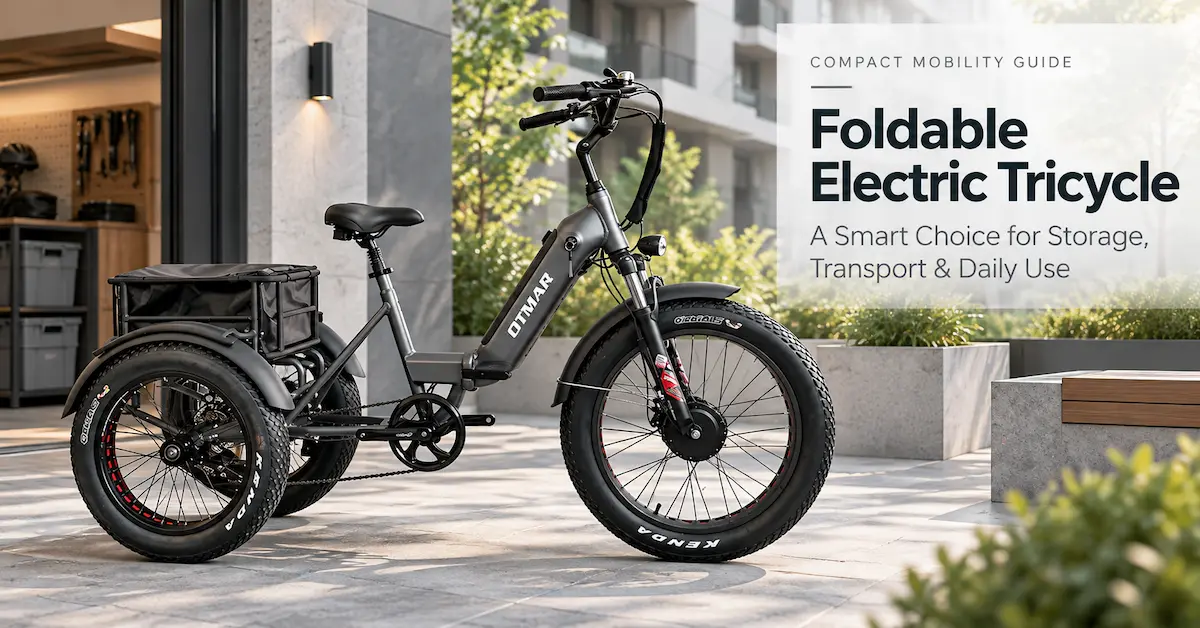
The OTM-T10 electric trike is currently presented with a 20-inch wheel configuration, front-drive motor, step-through frame, Kenda tires, hidden Samsung battery, and rear cargo compartment.
Its compact direction may be relevant where storage, rider access, and light carrying functions are important.
Commercial buyers should still request:
- Open and folded dimensions
- Folding mechanism details
- Vehicle weight
- Battery voltage and capacity
- Approved cargo limit
- Operating range under representative load
- Packaging dimensions
- Spare-parts list
A folding feature provides value only when it solves the actual storage or transport problem.
OTM-T16 for Utility and Mixed-Surface Routes
The OTM-T16 utility electric trike is presented with a front 24-inch/rear 20-inch layout, front-drive motor, Samsung battery, high-strength steel frame, front suspension, all-terrain tires, disc brakes, and rear cargo platform.
This direction may suit commercial users who need more utility space or operate across varied property routes.
Before approval, confirm:
- Exact platform dimensions
- Turning requirements
- Rider and cargo load definitions
- Battery specification
- Real-route range
- Suspension and brake service items
- Cargo mounting method
- Target-market compliance
OTM-T5 for Practical Carrying Tasks
The OTM-T5 electric tricycle is presented with a front 24-inch/rear 20-inch layout, front-drive system, Samsung battery, front suspension, front basket, rear cargo area, Kenda tires, and disc brakes.
It may offer a practical starting point for supplies, groceries, tools, or local service operations.
The current product description also discusses both cargo and passenger possibilities, but a commercial buyer should never assume passenger approval from general marketing language. Passenger use must be confirmed through the final structure, load definition, documentation, testing, and applicable market requirements.
Calculate Total Cost of Ownership, Not Only Purchase Price
The purchase price is only one part of the cost of an electric trike fleet.
A useful total cost of ownership model includes:
- Vehicle price
- Customization
- Samples
- Inspection
- Packaging
- Freight
- Duties and local charges
- Assembly
- Charging infrastructure
- Spare batteries
- Spare parts
- Scheduled maintenance
- Unscheduled repair
- Staff training
- Administration
- Downtime
- Replacement vehicles
- End-of-life or residual value
A simple framework is:
Total cost of ownership = acquisition + deployment + energy + maintenance + repair + downtime + replacement support − residual value
The calculation should be connected to productive use.
Useful commercial metrics include:
- Cost per operating day
- Cost per completed route
- Cost per kilometer
- Cost per delivery or service task
- Maintenance cost per vehicle
- Downtime hours per month
- Average repair time
- Fleet availability rate
A lower-priced vehicle may be more expensive over time if it requires difficult parts, creates long downtime, or uses several incompatible components across the fleet.
Control SKU and Component Complexity
Commercial operators often create unnecessary cost by buying too many configurations.
For example, a fleet may contain different:
- Batteries
- Chargers
- Brake parts
- Displays
- Tires
- Controllers
- Lights
- Keys
- Cargo boxes
Each difference increases training, inventory, documentation, and maintenance complexity.
A standardized fleet can make it easier to:
- Rotate vehicles
- Share chargers
- Stock parts
- Train employees
- Diagnose faults
- Place repeat orders
- Compare performance
Customization should support the business task—not create complexity without measurable value.
For buyers still comparing bulk purchasing models, the electric trike wholesale buying guide provides additional sourcing and repeat-order considerations.
Build a Commercial Charging Plan
Charging should be designed as part of the operating process.
Calculate Available Charging Time
Record:
- Shift end time
- Next shift start time
- Number of chargers
- Number of outlets
- Time available between routes
- Overnight access
- Weekend schedule
A fleet of ten vehicles does not automatically require ten simultaneous chargers, but the charging sequence must support the duty cycle.
Plan the Charging Area
The charging location should consider:
- Vehicle spacing
- Cable routing
- Walking clearance
- Outlet location
- Ventilation
- Access control
- Battery removal
- Charger labeling
- Inspection responsibility
- Emergency procedure
Charging cables should not create trip hazards or become trapped between vehicles.
Standardize Batteries and Chargers
Where possible, component standardization can simplify:
- Charger allocation
- Spare-battery planning
- Staff instructions
- Fault diagnosis
- Replacement ordering
The final battery and charger identifiers should be included in the approved specification and service documents.
Record Real Energy Use
During the pilot, record:
- Starting battery condition
- Ending battery condition
- Route distance
- Load
- Rider
- Assistance level
- Temperature
- Surface
- Charging time
This produces an operating baseline for future fleet planning.
Design Maintenance Around Uptime
A commercial maintenance plan should be established before vehicles enter service.
Daily Operator Check
A short pre-use check may include:
- Tire condition
- Tire pressure
- Brake response
- Steering
- Battery installation
- Lights
- Visible fasteners
- Cargo attachment
- Unusual noise
- Display warnings
The check should be simple enough for operators to complete consistently.
Scheduled Technical Inspection
Maintenance staff may inspect:
- Brake wear and adjustment
- Wheel condition
- Spokes
- Tire wear
- Steering components
- Drivetrain
- Cables
- Electrical connectors
- Battery mounting
- Charging equipment
- Frame and cargo structure
- Folding mechanism where applicable
Intervals should be defined according to use, environment, supplier guidance, and local practice.
Spare-Parts Planning
Before the first bulk order, identify:
- Fast-moving wear parts
- Critical electrical components
- Brake parts
- Tires and tubes
- Displays
- Chargers
- Lights
- Keys or locks
- Cargo hardware
- Model-specific components
The goal is not to stock every possible component. It is to prevent a minor failure from removing a vehicle from service for an extended period.
Fault Reporting
Use a consistent fault-reporting format:
- Vehicle ID
- Date
- Rider
- Mileage or operating hours
- Symptom
- Operating condition
- Photos
- Temporary action
- Final repair
- Parts used
- Downtime
This data helps distinguish isolated incidents from recurring fleet issues.
Run a Pilot Before Scaling the Fleet
A pilot is the bridge between product selection and commercial deployment.
It should answer whether the vehicle works within the complete operating system—not only whether it can be ridden.
Phase 1: Technical Acceptance
Confirm:
- Final specification
- Vehicle dimensions
- Motor and battery configuration
- Brakes
- Tires
- Cargo structure
- Accessories
- Branding
- Documentation
- Packaging
- Charger
- Spare parts
Phase 2: Controlled Route Testing
Use representative:
- Riders
- Loads
- Routes
- Slopes
- Surfaces
- Stops
- Charging conditions
Avoid testing only an empty vehicle on a short, smooth route.
Phase 3: Operational Pilot
Place the trike into real work under supervision.
Monitor:
- Route completion
- Staff acceptance
- Charging
- Cargo handling
- Parking
- Maintenance
- Vehicle availability
- Rider behavior
- Site interaction
Phase 4: Review and Specification Freeze
At the end of the pilot, classify each issue:
- Product issue
- Configuration issue
- Training issue
- Route issue
- Charging issue
- Maintenance issue
- Documentation issue
Not every problem requires a product redesign. Some can be solved through route planning, staff training, cargo organization, or charging procedures.
Once changes are approved, the final specification should become the production reference.
Use KPIs to Decide Whether to Scale
A pilot should have measurable success criteria.
| KPI | What It Reveals |
|---|---|
| Fleet availability | Percentage of vehicles ready for use |
| Route completion rate | Whether the platform completes assigned work |
| Average daily distance | Actual operational demand |
| Battery use per route | Energy requirement under real conditions |
| Charging turnaround | Whether charging supports the schedule |
| Maintenance labor | Service burden |
| Parts consumption | Wear and inventory needs |
| Downtime | Operational disruption |
| Rider acceptance | Ease of use and comfort |
| Cargo task completion | Whether carrying structure fits the work |
| Incident and near-miss reports | Training, route, or vehicle risks |
| Cost per task | Commercial efficiency |
The buyer should define acceptable performance before the pilot begins.
Without clear KPIs, teams may rely on general comments such as “the vehicle feels good,” which are not enough to support a fleet investment.
Commercial Safety and Compliance Planning
Commercial use can involve workplace rules, road-use laws, product standards, insurance requirements, battery transport rules, and site-specific safety procedures.
The relevant requirements depend on:
- Country
- Vehicle classification
- Motor power
- Assisted speed
- Intended road use
- Cargo or passenger function
- Electrical configuration
- Battery
- Workplace environment
Buyers should not assume that one configuration is automatically suitable for every market.
Documents may need to cover:
- Product identification
- Final specification
- User instructions
- Maintenance instructions
- Labels
- Battery and charger
- Transport documentation
- Applicable test reports
- Packaging
- Spare-parts references
OTMAR discusses its manufacturing and export background on the About Us page, but certification and compliance should still be confirmed for the final model, target market, and approved configuration.
OEM and Private-Label Options for Commercial Projects
Commercial customization should improve operation, identification, or maintenance.
Useful customization may include:
- Fleet colors
- Company logo
- Vehicle numbering
- Reflective identification
- Department labels
- Cargo boxes
- Tool holders
- Lockable storage
- Lighting
- Tires
- Battery configuration
- Packaging
- Manuals
- Spare-parts kits
Separate customization into three levels.
Branding Customization
This may include color, logo, decals, labels, and packaging.
It usually has limited impact on vehicle engineering but still needs controlled artwork and approval.
Functional Component Customization
This may include tires, lighting, display, battery, brakes, cargo accessories, or selected electrical parts.
These changes can affect compatibility, service, documentation, and compliance.
Structural Customization
This may include frame changes, cargo platforms, mounting structures, or special-purpose layouts.
Structural changes require deeper engineering review and sample validation.
OTMAR’s electric trike OEM development guide explains how branding, component, and structural customization should be separated before sample development.
What Should a Commercial Electric Trike RFQ Include?
A useful request for quotation should describe the work, not only the desired product.
Include:
- Destination country
- Buyer type
- Industry
- Fleet size
- Expected order quantity
- Intended users
- Route distance
- Operating hours
- Shift pattern
- Surface
- Gradient
- Stop frequency
- Rider weight range
- Cargo type
- Cargo weight
- Cargo dimensions
- Storage limits
- Doorway and pathway limits
- Charging access
- Required accessories
- Branding
- Documentation
- Spare-parts expectations
- Pilot quantity
- Testing plan
- Target schedule
Avoid sending only:
“Please quote your best electric trike for commercial use.”
A detailed RFQ makes it easier to compare relevant solutions and reduces the risk of receiving quotations for vehicles that do not fit the operation.
Common Commercial Electric Trike Procurement Mistakes
Selecting by Motor Power Alone
A high motor number does not prove that the frame, brakes, battery, cargo structure, geometry, and control system match the task.
Using Advertised Range as a Fleet Guarantee
Range changes with load, rider, route, speed, temperature, tire pressure, and assistance level.
Test the real duty cycle.
Ignoring Width and Turning Space
This is one of the most expensive mistakes because it may not appear until the vehicle reaches the site.
Measure the complete operating route before ordering.
Confusing a Rear Rack With Approved Cargo Capacity
The physical presence of a rack does not define its permitted load.
Request documented load definitions.
Assuming Cargo and Passenger Use Are Interchangeable
A cargo platform should not automatically be used for passengers.
Passenger use requires a suitable structure, load definition, documentation, and compliance pathway.
Over-Customizing the First Order
Too many new components can make sample approval, parts planning, maintenance, and repeat production more difficult.
Begin with the smallest set of changes that creates real operational value.
Failing to Plan Spare Parts
A low-cost vehicle can create high downtime if basic replacement parts are difficult to identify or obtain.
Skipping the Pilot
A catalog, specification sheet, and short demonstration cannot reproduce the complete commercial workflow.
Approving a Sample Without Freezing the Specification
The approved sample should be connected to a controlled component list, appearance standard, accessories, labels, documents, and packaging.
Buying a Fleet Without Assigning Maintenance Responsibility
Every fleet needs a defined owner for inspection, charging, fault reporting, service coordination, and parts inventory.
Frequently Asked Questions About Electric Trikes for Commercial Use
What is an electric trike for commercial use?
An electric trike for commercial use is a three-wheel electric vehicle selected and configured to complete a repeatable business task. Applications may include property maintenance, campus operations, hotel support, park services, internal transport, light delivery, utility work, and community mobility.
Commercial suitability depends on duty cycle, load, route, charging, rider profile, maintenance, parts, compliance, and total operating cost.
Are electric trikes suitable for resorts and hotels?
They may be suitable for staff transport, inspections, housekeeping support, maintenance, supplies, and internal property movement.
The operator should evaluate route surface, guest interaction, storage, charging, cargo, rider training, appearance, and low-speed control before deployment.
Can an electric trike be used in a warehouse or factory?
A trike may support internal movement in large facilities, but buyers should first check aisle width, turning space, floor condition, pedestrian traffic, cargo dimensions, parking, charging rules, visibility, and site safety procedures.
For indoor use, predictable control and compact dimensions may be more important than maximum speed.
How much cargo can a commercial electric trike carry?
There is no universal cargo figure.
Buyers need separate definitions for rider load, cargo-structure load, accessory weight, and total permitted load. The final limit must come from the approved model and configuration.
The weight of boxes, racks, locks, and other accessories should be included in the calculation.
What battery size is best for a commercial fleet?
The best battery depends on route distance, total daily distance, load, gradients, stop frequency, speed, assistance level, weather, charging time, and shift schedule.
Instead of selecting only by capacity, test a representative route and record starting battery condition, ending condition, distance, rider, load, surface, and operating mode.
Should commercial fleets use removable batteries?
Removable batteries may simplify indoor charging, battery rotation, and security in some projects.
However, buyers should also evaluate locking, handling weight, connector durability, labeling, storage, replacement availability, and staff procedures.
A fixed battery may be practical when vehicles have direct access to a secure charging location.
How many electric trikes should a commercial pilot include?
The pilot should be large enough to test representative riders, routes, loads, charging, and maintenance without creating unnecessary early risk.
The correct number depends on the size and complexity of the operation. More important than a universal quantity is having clear KPIs, controlled specifications, representative conditions, and a defined review process.
How should a commercial electric trike be maintained?
Maintenance should combine a short operator pre-use check with scheduled technical inspection.
Typical areas include tires, brakes, steering, fasteners, drivetrain, electrical connectors, battery mounting, lights, frame, cargo structure, and charging equipment.
The exact schedule should reflect operating intensity, environment, supplier guidance, and applicable local requirements.
What spare parts should fleet buyers order?
Common planning areas include brake parts, tires, tubes where applicable, chargers, lights, displays, keys, cables, electrical components, cargo hardware, and model-specific wear items.
The initial spare-parts kit should be based on fleet size, operating intensity, local service capability, and expected lead time.
Is a folding electric trike suitable for commercial use?
A folding model can be useful when storage, transport, or deployment between locations is important.
Buyers should confirm folded dimensions, vehicle weight, folding sequence, locking structure, cable routing, repeated-cycle performance, and compatibility with the cargo setup.
Foldable does not automatically mean lightweight or easy for one person to lift.
Can commercial electric trikes be customized?
Depending on the platform, customization may include color, branding, labels, packaging, lighting, tires, battery, display, cargo systems, and selected structural features.
Functional and structural changes require more validation than cosmetic branding.
How do I compare commercial electric trike suppliers?
Compare:
- Application understanding
- Specification control
- Product platforms
- Engineering communication
- Sample process
- QC
- Component consistency
- Documentation
- Spare parts
- OEM capability
- Repeat-order management
- After-sales support
The lowest unit price should not be the only decision criterion.
What information should I send to request a quotation?
Send the destination market, fleet size, order quantity, application, rider profile, route, operating hours, load, storage limits, charging conditions, customization, spare-parts needs, pilot plan, and target schedule.
This allows the supplier to recommend a platform and identify information that still needs confirmation.
Conclusion
Choosing an electric trike for commercial use requires more than comparing motor power, range, or purchase price. Fleet buyers should define the duty cycle, verify site access, test the real load, plan charging and maintenance, measure pilot KPIs, and control the approved configuration before scaling.
To evaluate a trike for a resort, campus, property, facility, utility fleet, or private-label project, submit your route, load, fleet quantity, storage limits, and customization requirements through the OTMAR Contact Us page for a commercial configuration and sample-plan discussion.