
Why Buy a Foldable Electric Tricycle Instead of a Standard Trike?
A foldable electric tricycle is most valuable when storage and transport constraints are part of the real operating problem.
For distributors, dealers, mobility brands, resorts, community programs, and fleet operators, a folding design may make three-wheel mobility easier to store, move between locations, or integrate into facilities where a full-size trike occupies too much space.
However, “foldable” should not be treated as a simple convenience feature.
A buyer still needs to evaluate:
- How much space the vehicle actually saves when folded
- Which parts fold
- How the folding structure locks
- Whether cables or components are stressed during folding
- How easily staff or riders can operate the mechanism
- Whether the folded vehicle can realistically be transported
- Whether folding affects cargo, battery, or accessory use
- How the structure behaves after repeated folding cycles
This makes foldability a system-level purchasing decision, not simply another line on a specification sheet.
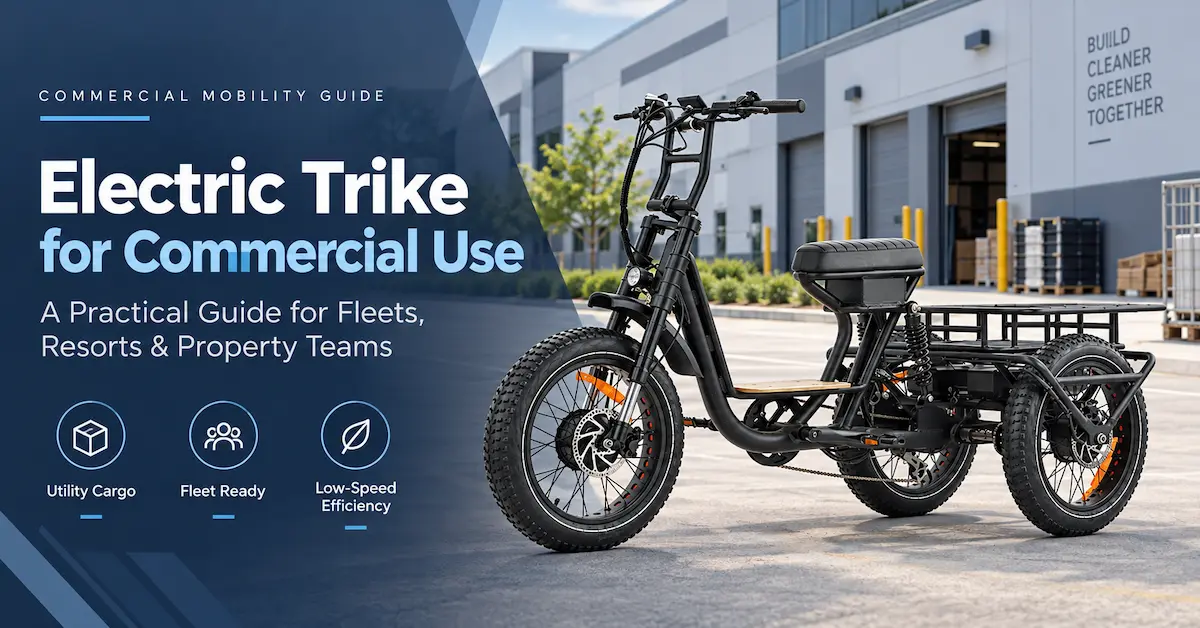
Buyers comparing current three-wheel platforms can first review the OTMAR electric trike range before deciding whether compact storage should be a primary selection criterion.
When Does a Foldable Electric Tricycle Make the Most Sense?
Not every electric tricycle project needs a folding structure.
The strongest applications are usually those where the vehicle repeatedly encounters a storage or transportation constraint.
Space-Limited Urban Storage
Urban dealers and end users may need to store a trike in:
- Garages
- Shared storage rooms
- Ground-floor apartments
- Retail back rooms
- Small warehouses
- Covered parking areas
A folding platform can reduce storage pressure, but the buyer should request actual folded dimensions, not assume that folding automatically makes the vehicle compact enough.
Resorts, Hotels, and Tourism Operations
Hospitality operators may need to move mobility equipment between buildings or store vehicles outside operating hours.
Their priorities may include:
- Compact overnight storage
- Easy deployment by staff
- Simple charging access
- Rider comfort
- Low-step entry
- Basket or cargo capacity
The operational question is not simply whether the tricycle folds.
It is whether staff can fold, store, move, charge, and redeploy it efficiently every day.
Campuses and Large Properties
Universities, residential communities, parks, and large facilities may operate vehicles across several zones.
A foldable electric tricycle may be useful when vehicles need to be:
- Relocated by service vehicle
- Stored seasonally
- Rotated between sites
- Kept in limited maintenance areas
For these buyers, folding speed, transport dimensions, vehicle weight, and staff handling become part of the fleet workflow.
Dealers and Distributors
Dealers may value folding platforms because storage and showroom space are limited.
But the commercial advantage only exists if the model also delivers:
- Clear customer positioning
- Reliable specifications
- Easy demonstration
- Serviceable components
- Repeat-order consistency
A compact product that creates difficult maintenance or complicated folding instructions may not be commercially attractive.
Foldable Does Not Automatically Mean Portable
This distinction is important.
A vehicle can fold and still be relatively heavy.
Electric tricycles include components such as:
- Frame
- Three wheels
- Motor
- Battery
- Braking system
- Rear structure
- Cargo equipment
- Electrical components
A folding mechanism may reduce the vehicle's footprint without making it suitable for one person to lift.
Before purchasing, ask three separate questions:
Can it fold?
This describes the structural function.
How small is it when folded?
This determines whether it solves the intended storage problem.
Can the target user or staff actually move it?
This determines real-world portability.
These questions should not be treated as interchangeable.
For example, a vehicle may fit into a storage area once folded but still require a ramp or two-person handling when loaded into a van.
What Folding Specifications Should B2B Buyers Request?
A standard electric trike specification sheet is not enough for a folding model.
Buyers should request folding-specific information.
Open and Folded Dimensions
Request both:
- Riding dimensions
- Folded length
- Folded width
- Folded height
Then compare those numbers with the actual operating environment.
For a fleet project, measure:
- Storage doorway
- Elevator
- Vehicle loading area
- Warehouse aisle
- Parking bay
- Storage rack or room
A product should fit the real space—not just appear compact in a photograph.
Folding Point
Understand which section of the tricycle folds.
Depending on the design, the folding function may involve part of the:
- Main frame
- Handlebar structure
- Rear section
- Steering assembly
Buyers should not assume a specific mechanism from the category name alone.
The actual folding structure should be confirmed on the current model and production specification.
Locking Mechanism
The folded and deployed positions both need controlled locking.
During sample evaluation, inspect:
- Main latch
- Secondary retention method
- Fastener condition
- Play around the folding joint
- Ease of engagement
- Visual confirmation of correct locking
A mechanism that is difficult to identify as “fully locked” may create user-error risk.
Cable Routing
Folding changes the movement of:
- Brake cables
- Electrical wiring
- Display cables
- Lighting wires
Repeated folding should not cause cables to become:
- Pinched
- Stretched
- Twisted
- Abraded
- Trapped between frame sections
Cable routing is therefore an important sample-inspection point.
How Should the Folding Joint Be Evaluated?
For B2B buyers, the folding joint deserves more attention than the marketing photo.
The joint repeatedly experiences mechanical movement each time the vehicle is folded and reopened.
During evaluation, check:
Alignment
After unfolding, the frame should return consistently to its correct operating position.
Inspect whether repeated operation changes:
- Steering alignment
- Frame position
- Wheel tracking
- Latch engagement
Movement or Free Play
Excessive movement around a joint can affect riding confidence and long-term service requirements.
The sample should be checked both when new and after repeated folding cycles.
Ease of Operation
A mechanism may be technically functional but operationally inconvenient.
Ask representative users or staff to perform the complete process.
Record:
- Number of steps
- Tools required
- Difficult points
- Risk of pinched fingers
- Need to support vehicle weight
- Time required for deployment
For fleet customers, a small inconvenience repeated dozens of times per day can become a meaningful operating issue.
Storage Footprint Is More Important Than the Word “Folding”
A practical buying decision should compare space saved, not simply whether the frame folds.
Consider a facility storing ten vehicles.
A small reduction in width may significantly improve parking density, while a fold that mainly shortens the frame may provide little benefit in that particular room.
Buyers should calculate:
Storage requirement = folded footprint × fleet quantity + safe access space
This is especially useful for:
- Rental fleets
- Hotels
- Campuses
- Dealer inventory
- Seasonal storage
- Commercial facilities
For fleet projects, test several vehicles together rather than evaluating only one sample in an empty room.
Can a Foldable Electric Tricycle Be Transported in a Vehicle?
Potentially—but this should be tested with the actual vehicle and transport platform.
A buyer should compare:
- Folded dimensions
- Vehicle weight
- Van or trailer opening
- Loading height
- Tie-down locations
- Battery handling
- Movement during transport
Do not assume that folding alone makes the tricycle suitable for a car trunk.
Three-wheel vehicles can still have considerable width, wheel mass, and structural volume even after folding.
For a commercial operation, a simple loading trial can reveal more than a long specification sheet.
Test:
- Fold the vehicle.
- Move it to the transport vehicle.
- Load it using the intended staff.
- Secure it.
- Check surrounding clearance.
- Unload it.
- Reopen it.
- Perform a short functional inspection.
This produces a realistic view of the complete transport workflow.
Rider Access Still Matters After You Solve Storage
A folding platform should not sacrifice usability.
For many three-wheel mobility applications, rider access is one of the major reasons for choosing a tricycle in the first place.
Evaluate:
- Step-through height
- Saddle position
- Handlebar reach
- Starting posture
- Foot placement
- Rider balance at low speed
- Ease of mounting and dismounting
A compact folding design is only valuable when the vehicle remains suitable for the intended rider.
For B2B buyers, rider testing should include people who resemble the actual target customer—not only factory or purchasing staff.
Battery and Charging Design Affect Storage Planning
Battery configuration can change how a foldable electric tricycle is stored and operated.
Ask:
- Is the battery removable?
- Can it be charged on the vehicle?
- Where is the charging port?
- Is the port accessible when the vehicle is stored?
- Will several folded vehicles block each other's charging access?
- Where will spare batteries be stored?
- Can staff identify each battery and charger?
Fleet buyers should design the storage and charging process together.
A room that can physically hold ten folded trikes may still be unsuitable if charging cables, ventilation, walking space, or battery handling are poorly planned.
Cargo Features Can Change Folding Practicality
Many electric tricycles combine mobility with carrying functions.
Cargo structures may include:
- Rear compartments
- Baskets
- Platforms
- Rails
- Custom boxes
These features can change the practical folded footprint.
Before ordering, verify whether accessories:
- Remain attached during folding
- Must be removed first
- Interfere with the folding path
- Increase folded width or height
- Require separate storage
A useful product configuration should balance storage efficiency and daily carrying requirements.
If cargo use matters more than compact storage, a non-folding utility platform may sometimes be the better choice.
Foldable vs Non-Foldable Electric Tricycle
| Buying Factor | Foldable Electric Tricycle | Non-Foldable Electric Tricycle |
|---|---|---|
| Storage flexibility | Potentially better | Usually requires full footprint |
| Transport between sites | May be easier | Can require more loading space |
| Structural simplicity | More moving interfaces | Usually fewer folding interfaces |
| Daily deployment | Requires fold/unfold procedure | Ready to use |
| Inspection focus | Latch, joint, cables, alignment | General frame and component checks |
| Best fit | Space-sensitive mobility | Continuous use where storage is less constrained |
| Buyer priority | Folded dimensions and mechanism | Utility, cargo, durability, or simplicity |
Neither structure is automatically better.
The correct choice depends on the operating environment.
OTM-T10 as a Folding Electric Trike Platform
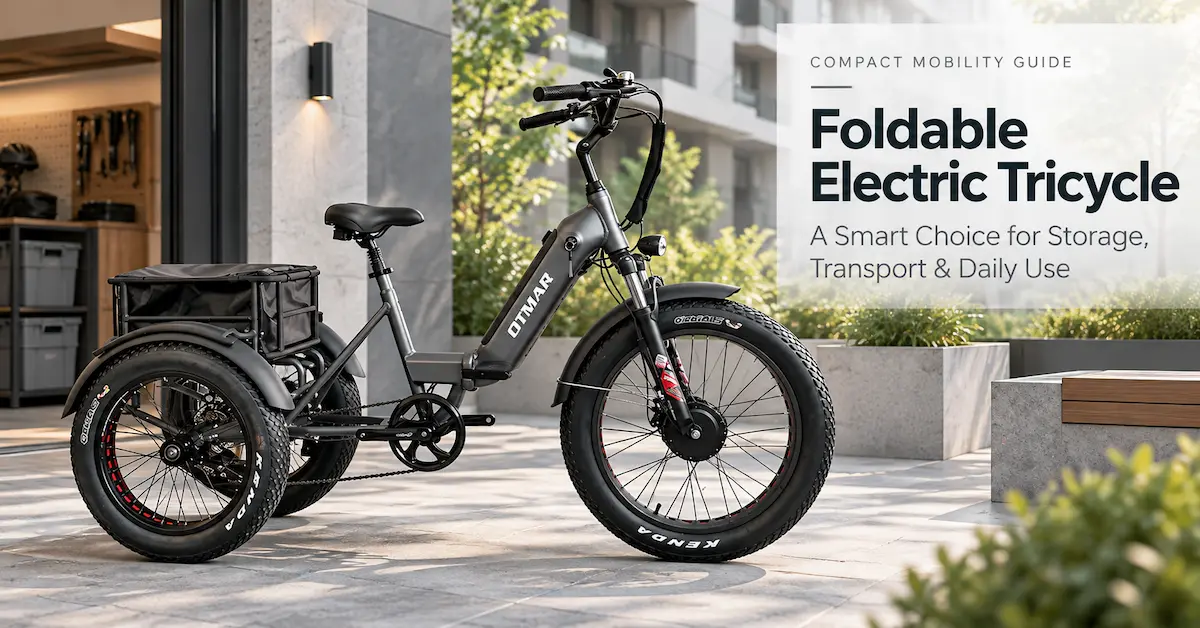
OTMAR currently positions the OTM-T10 as a folding electric trike platform in its product and B2B content.
Published product information identifies several relevant characteristics, including:
- 20-inch wheel configuration
- 750W front-drive motor
- Samsung battery
- Step-through structure
- Kenda tires
- Rear cargo compartment
Buyers can review the OTM-T10 electric tricycle as a starting point for a compact three-wheel mobility project.
However, the currently published information does not provide every folding-specific purchasing dimension.
For a serious procurement project, request confirmation of:
- Exact folded dimensions
- Folding sequence
- Locking mechanism
- Vehicle weight
- Current battery specification
- Intended load
- Final configuration
- Packaging dimensions
This is preferable to inferring these details from product photography or a category description.
What Should Be Tested on a Foldable Electric Tricycle Sample?
A folding model needs both conventional electric-trike testing and folding-specific validation.
Folding Function Test
Repeat the fold/unfold process and inspect:
- Lock engagement
- Secondary safety feature
- Joint movement
- Alignment
- Cable routing
- Interference
- Fastener condition
Storage Test
Place the vehicle in the intended storage environment.
Check:
- Door clearance
- Parking density
- Handling space
- Charging access
- Ability to move neighboring vehicles
Transport Test
Load and unload the sample using the intended vehicle and staff.
Do not simulate this only on paper.
Riding Test
After repeated folding, verify:
- Steering
- Braking
- Motor operation
- Electrical display
- Lighting
- Rider position
- Low-speed handling
Cargo Test
If the vehicle includes a rear compartment or carrying structure, test it under the intended loading condition.
Also verify whether cargo accessories change the folding process.
Why Repeated Folding Matters for Fleet Buyers
A private user may fold a vehicle occasionally.
A commercial fleet may fold it much more frequently.
That difference changes the purchasing question.
For a fleet, estimate:
folding cycles per day × operating days × expected service period
Even without assigning a theoretical durability number, this calculation helps buyers understand how important the folding joint, latch, cables, and staff procedure will become.
A fleet buyer should also ask how the supplier handles:
- Replacement hardware
- Latch components
- Fasteners
- Cable wear
- Adjustment procedures
- Service documentation
A folding platform is easier to operate long term when wear-related components can be identified and serviced.
Foldable Electric Tricycle QC Before Mass Production
Once a sample is approved, the folding structure should become part of the production inspection plan.
Typical checks can include:
Structural Inspection
- Frame
- Folding joint
- Locking mechanism
- Fasteners
- Wheel installation
- Steering
Electrical Inspection
- Battery installation
- Motor function
- Controller
- Display
- Lighting
- Cable routing
Functional Inspection
- Folding
- Unfolding
- Lock engagement
- Steering
- Braking
- Power assistance
- Charging
Project-Specific Inspection
- Branding
- Accessories
- Cargo compartment
- Packaging
- Labels
The goal is not only for one sample to work.
The production batch should reproduce the approved configuration consistently.
Buyers planning customized projects can also review the OTMAR electric trike OEM guide for the broader sample-to-production process.
OEM Considerations for a Folding Electric Tricycle
Customization should be especially controlled on a folding platform.
Branding Changes
Lower-risk customization may include:
- Frame color
- Logo
- Decals
- Packaging
- Product labels
Component Changes
Motor, battery, display, brake, tire, or lighting changes can affect compatibility and service planning.
Structural Changes
Changes around:
- Main frame
- Folding area
- Cargo structure
- Mounting points
require deeper engineering review.
A structural modification should never be treated as merely a cosmetic OEM request.
If the original folding geometry changes, the project may need additional sample validation before production approval.
When a Foldable Electric Tricycle May Not Be the Best Choice
A folding tricycle is not automatically the best solution for every customer.
A non-folding platform may be more appropriate when:
- Vehicles remain outdoors or in large dedicated parking areas
- They operate continuously throughout the day
- Storage space is not constrained
- Maximum structural simplicity is preferred
- Large permanent cargo structures are required
- The product rarely needs to be transported between locations
In those cases, buyers may benefit more from evaluating utility, cargo, comfort, or terrain requirements.
The OTMAR electric trike range provides different platform directions for comparison.
What Should Be Included in a Foldable Electric Tricycle RFQ?
A useful RFQ should explain the storage problem as clearly as the vehicle requirement.
Include:
- Destination market
- Buyer type
- Estimated quantity
- Target rider
- Primary application
- Riding environment
- Maximum available storage space
- Required folded dimensions, if known
- Transport vehicle dimensions
- Expected folding frequency
- Cargo requirements
- Battery and charging requirements
- Branding needs
- Packaging requirements
- Spare-parts expectations
- Sample-testing plan
This gives the supplier enough context to determine whether a folding platform is actually suitable.
Buyer Checklist Before Approving a Folding Electric Trike
Before approving a model, confirm:
Storage
- Open dimensions confirmed?
- Folded dimensions confirmed?
- Storage access measured?
- Charging layout planned?
Folding mechanism
- Folding sequence understood?
- Locking mechanism inspected?
- Secondary retention checked?
- Cables clear during movement?
- Repeated operation tested?
Transport
- Vehicle can be moved by intended staff?
- Transport vehicle tested?
- Loading method defined?
- Tie-down method considered?
Rider use
- Step-through access appropriate?
- Rider position comfortable?
- Steering and braking verified?
- Target-user testing completed?
Commercial
- Final specification recorded?
- Sample approved?
- Spare parts identified?
- Component-change process agreed?
- Packaging confirmed?
If several of these remain unanswered, the product is not yet ready for a confident bulk decision.
Frequently Asked Questions About Foldable Electric Tricycles
What is a foldable electric tricycle?
A foldable electric tricycle is a three-wheel electric vehicle designed with a structure that can reduce its dimensions for storage or transport. The exact folding method varies by platform, so buyers should confirm which parts fold and the final folded dimensions.
Is a foldable electric tricycle easier to transport?
It can be, but folding does not automatically mean lightweight or easy to lift. Vehicle weight, folded dimensions, loading height, and staff handling should all be tested.
What dimensions should buyers request?
Request both operating and folded length, width, and height. For commercial use, compare those numbers with storage doors, elevators, vans, warehouses, and parking areas.
Is a folding electric trike suitable for fleet use?
It can be suitable when storage or site-to-site transportation is important. Fleet buyers should additionally evaluate folding frequency, staff workflow, service parts, charging, and repeat-cycle durability.
Does the folding mechanism require maintenance?
Any moving mechanical interface may require inspection and adjustment. Buyers should ask how the latch, fasteners, joint, and related components are inspected and serviced.
Is a folding electric tricycle the same as a lightweight tricycle?
No. Folding refers to reducing dimensions; lightweight refers to vehicle mass. A trike can fold while still being too heavy for one person to lift comfortably.
Can a foldable electric tricycle still have cargo space?
Yes, depending on the platform. However, buyers should verify whether the cargo compartment or accessories affect folding dimensions or need to be removed.
Should I test a sample before a bulk order?
Yes. Sample validation is particularly useful for checking folded dimensions, mechanism operation, storage, transport, rider access, electrical functions, and application fit before mass production.
Can a foldable electric tricycle be customized?
Branding, color, packaging, accessories, and selected components may be customizable depending on the platform. Structural changes around the folding area require more careful engineering validation.
Where can I discuss a foldable electric tricycle project?
Buyers can provide their target market, quantity, storage constraints, operating environment, customization requirements, and sample needs through the OTMAR Contact Us page.
Conclusion
A foldable electric tricycle should be selected for the problem it solves: reducing storage pressure, simplifying transport between locations, or improving deployment flexibility. The most important buying checks are the actual folded footprint, locking structure, repeated folding behavior, rider access, transport workflow, serviceability, and consistency between the approved sample and production units.
If you are evaluating a folding electric trike for distribution, private label, resort, campus, community mobility, or fleet use, send your required quantity, storage dimensions, application, and customization requirements through the OTMAR Contact Us page to discuss whether the current folding platform fits your project.